
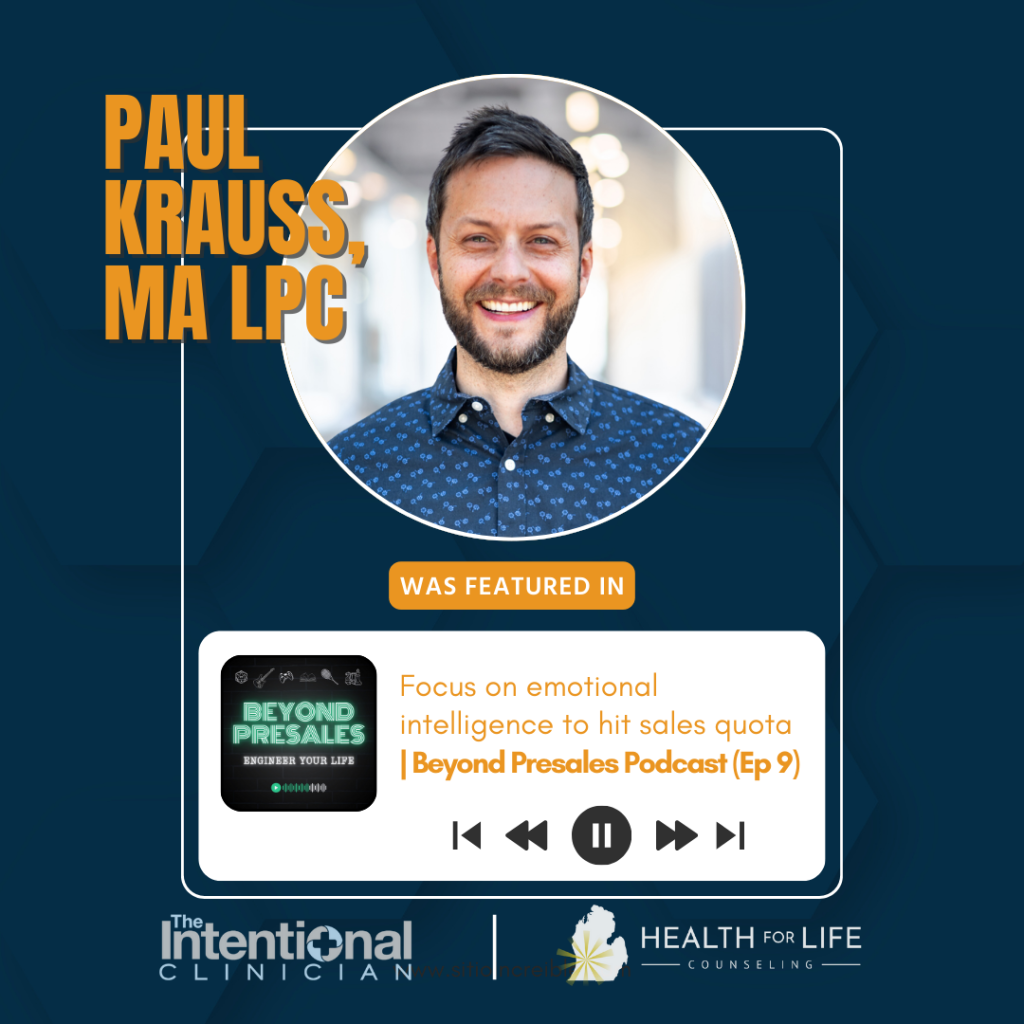
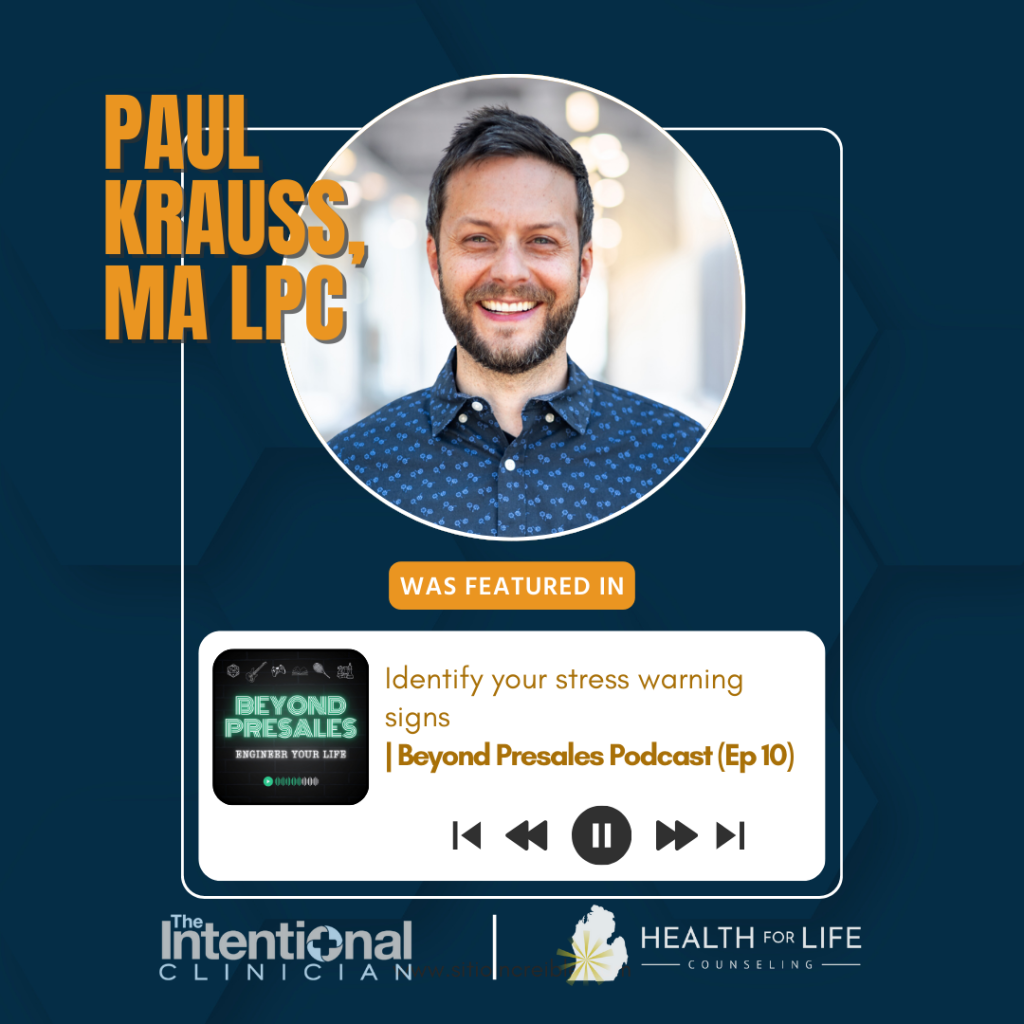
Paul Krauss MA LPC was featured in two recent episodes of Jack Cochran’s Beyond Presales Podcast.
After spending nearly a decade as a customer, Jack Cochran made the transition to presales in 2013, giving him a unique dual perspective on sales strategies. Drawing from his experiences on both sides of the sales process, he has gained valuable insights into what works and what doesn’t. The idea for Beyond Presales emerged in 2021 as Jack sought to blend traditional solution selling techniques with the evolving needs and expectations of modern buyers.
Part 1:
Jack Cochran is joined by Paul Krauss to talk about the actual mental health science around focusing on yourself and the benefits to your job when you do so.
Part 2:
Jack Cochran is joined by Paul Krauss. We continue our conversation from the last episode. Today we explore how to better identify the things that lead to burnout and how to deal with it when you are experiencing high stress.
Book discussed during part 2 of the interview:
Panic Proof: The New Holistic Solution to End Your Anxiety Forever by Dr. Nicole Cain
Articles References During the Podcast Episodes by Topic:
- That working on personal development helps employees, executives and sales representatives do better in their jobs and personal lives.
Employees:
- Kumar et al., (2018) shows the positive impact of employee development programs on both employees and organizations, as it helps employees to develop their skills and organizations to retain the most valued human resource.
Kiran Kumar, P., Kumar, P. B. R., & Chandrika, B. K. (2018). Impact of training and development on employees’ performance. Retrieved from https://diet.edu.in/cmoon_images/mba3.p.kiran_kumar_dr._rama_kumar.p.b_k._chandrika_.pdf
- Chawla, D., Dokadia, A., & Pathak, H. (2021). A study on the impact of workplace spirituality on employee outcomes mediated by job satisfaction and person-job fit. Journal of Work-Applied Management, 13(2), 215-230. https://doi.org/10.1108/JWAM-04-2021-0030
This study shows that psychologically informed coaching techniques led to effective work-related outcomes, particularly on goal attainment and employees’ self-efficacy.
- Kumar, D., & Kumar, S. (2020). Benefits of training and development programs on employees’ performance: A study with special reference to the banking sector in Bangladesh.
Kumar & Kumar (2020) shows that training and development programs significantly enhance the skills, abilities, and intellectual capacities of employees in the banking sector and enhance their overall job performance.
- Lejeune, C., Beausaert, S., & Raemdonck, I. (2018). The impact on employees’ job performance of exercising self-directed learning within personal development plan practice. The International Journal of Human Resource Management, 32(5), 1086–1112. https://doi.org/10.1080/09585192.2018.1510848
According to Lejeune et al., (2018), self-directed learning (SDL) within personal development plans (PDPs) significantly enhances employees’ job performance.
Executives:
- Hooijberg, R., & Lane, N. (2009). Using multisource feedback coaching effectively in executive education. Academy of Management Learning & Education, 8(4), 483–493. https://doi.org/10.5465/AMLE.2009.47785468
A 2009 study explored the effectiveness of multisource feedback within executive education programs and found that the addition of coaching significantly enhances performance improvements.
Sales representatives:
- Manna, D.R. and Smith, A.D. (2004), “Exploring the need for emotional intelligence and awareness among sales representatives”, Marketing Intelligence & Planning, Vol. 22 No. 1, pp. 66-83. https://doi.org/10.1108/02634500410516922
Manna & Smith (2004) suggested emotional intelligence training to be integrated into sales training programs. The research found that emotional intelligence components ( identifying personality types, presentation skills, and adaptability) are crucial for success in sales roles.
- Having a satisfying life outside of work is the key to better work performance and avoiding “burn out.”
Studies show that having a satisfying life outside of work contributes to better work performance and mental health in the workspace. For example, a study by Boamah et al. (2022) found that increased work-life interference contributes significantly to burnout, higher turnover intentions, and reduced career satisfaction (Boamah et al., 2022). On the other hand, maintaining a healthy work-life balance and personal happiness significantly enhances employee performance (Bataineh, 2019).
According to Volk et al., (2023), work-life balance is essential to reducing burnout and improving well-being.
Similarly, Irfan et al. (2023) found that work-life balance is related to work-family conflicts and significantly affects job burnout and project performance. Furthermore, factors such as work-life balance, job satisfaction, and organizational commitment are positively correlated with employee performance (Abdirahman et al., 2020).
- Boamah, S. A., Hamadi, H. Y., Havaei, F., Smith, H., & Webb, F. (2022). Striking a Balance between Work and Play: The Effects of Work-Life Interference and Burnout on Faculty Turnover Intentions and Career Satisfaction. International journal of environmental research and public health, 19(2), 809. https://doi.org/10.3390/ijerph19020809
- Bataineh, K. (2019). Impact of Work-Life Balance, Happiness at Work, on Employee Performance. International Business Research. https://www.ccsenet.org/journal/index.php/ibr/article/view/0/38180
- Volk JO, Schimmack U, Strand EB, Reinhard A, Hahn J, Andrews J, Probyn-Smith K, Jones R. Work-life balance is essential to reducing burnout, improving well-being. J Am Vet Med Assoc. 2024 May 10;262(7):950-957. https://doi.org/10.2460/javma.24.02.0135
- Irfan, M., Khalid, R.A., Kaka Khel, S.S.U.H., Maqsoom, A. and Sherani, I.K. (2023), “Impact of work–life balance with the role of organizational support and job burnout on project performance”, Engineering, Construction and Architectural Management, Vol. 30 No. 1, pp. 154-171. https://doi.org/10.1108/ECAM-04-2021-0316
- Abdirahman, H., Najeemdeen, I., Abidemi, B., & Ahmad, R. (2020). The Relationship between Job Satisfaction, Work-Life Balance and Organizational Commitment on Employee Performance. ADVANCES IN BUSINESS RESEARCH INTERNATIONAL JOURNAL, 4(1), 42-52. https://myjms.mohe.gov.my/index.php/ABRIJ/article/view/10081
- Does “self-awareness” help one be better at their vocation?
Many studies show that self-awareness plays a significant role in leaders’ personal and professional development (e.g., Tekleab et al., 2008; Bratton et al., 2011). For instance, according to Showry & Manasa (2014), self-awareness is a key to effective leadership, as it contributes to self-actualization and managerial effectiveness.
The findings of Godarzi et al., (2019) also show that self-awareness directly enhances job performance by increasing self-development. Furthermore, according to Sutton et al., (2015), self-awareness is positively associated with job-related well-being and leads to improved communication with colleagues and increased confidence.
- Showry, Mendemu and Manasa, K.V.L., Self-Awareness – Key to Effective Leadership (October 7, 2014). The IUP Journal of Soft Skills, Vol. VIII, No. 1, March 2014, pp. 15-26, Available at SSRN: https://ssrn.com/abstract=2506605.
- Godarzi, M. A., Mazari, E., & Khabare, K. (2019). The Mediating Role of Self-Development on the Relationship between Self-Awareness and Job Performance. Organizational Culture Management, 17(4), 531-548. Doi: 10.22059/jomc.2019.262101.1007574
- Tekleab, A. G., Sims, H. P., Jr., Yun, S., Tesluk, P. E., & Cox, J. (2008). Are we on the same page? Effects of self-awareness of empowering and transformational leadership. Journal of Leadership & Organizational Studies, 14(3), 185–201. https://doi.org/10.1177/1071791907311069.
- Bratton, V. K., Dodd, N. G., & Brown, F. W. (2011). The impact of emotional intelligence on accuracy of self-awareness and leadership performance. Leadership & Organization Development Journal, 32(2), 127–149. https://doi.org/10.1108/01437731111112971.
- Sutton, A., Williams, H.M. and Allinson, C.W. (2015), “A longitudinal, mixed method evaluation of self-awareness training in the workplace”, European Journal of Training and Development, Vol. 39 No. 7, pp. 610-627. https://doi.org/10.1108/EJTD-04-2015-0031
- The statistics on work burnout and career satisfaction in the USA (currently)
According to SHRM’s Employee Mental Health in 2024 Research Series, 44% of US employees feel burned out at work, 45% feel emotionally drained from their work, and 51% feel “used up” at the end of the workday. This, in turn, negatively affects their job satisfaction — specifically, workers who feel “burned out” are 3 times more likely to actively seek a new job. On the other hand, 33% of employees have a positive work-life balance plan to maintain their current jobs.
Even though about 4 out of 10 people worldwide feel satisfied with their jobs, 45% of the workers feel burned out — they can’t maintain work-life balance; as a result of emotional exhaustion related to work, they can’t attend the gym regularly, and as a result, half of the people who consider themselves overweight attribute this problem to their work-related lifestyle.
According to APA’s 2024 Work in America survey, 45% of workers have to work more hours per week than they want to. This often results in burnout — as 67% of workers say, in the last month, they have experienced at least one burnout symptom, such as lack of interest, low energy, feeling isolated, and a lack of effort at work. These results point out the need for mental health support in the workplace.
- That learning to use mindfulness can be helpful in a job.
Studies show that using mindfulness is related to decreased stress at work. For example, according to Toniolo-Barrios & ten Brummelhuis (2023), mindfulness helps employees view work tasks less as a threat and as a result, this technique reduces stress at work. Aydoğmuş (2022) further shows that mindfulness enhances self-esteem, which is positively related to job performance.
Chen et al., (2022) also showed that mindfulness training is an effective tool to influence employees’ psychological states, such as meaningfulness, competence. This, in turn, leads to better work engagement.
Moreover, as Van Gordon et al., (2014) demonstrate, mindfulness trainings in workplace settings help employees transfer the locus of control for stress from external work conditions to internal resources and thus, positively affects their mental health and job performance.
- Toniolo-Barrios, M., & ten Brummelhuis, L. L. (2023). Work? A two-study examination using a stress appraisal perspective. Personality and Individual Differences, 112392. https://doi.org/10.1016/j.paid.2023.112392
- Aydoğmuş, C. (2022). Mindfulness and job performance: The mediating role of self-esteem. Trends in Business and Economics, 36(4), 315-324. https://dergipark.org.tr/tr/download/article-file/2714800
- Chen L, Li X and Xing L (2022) From mindfulness to work engagement: The mediating roles of work meaningfulness, emotion regulation, and job competence. Front. Psychol. 13:997638. doi: 10.3389/fpsyg.2022.997638
- Van Gordon, W., Shonin, E., Zangeneh, M. et al. Work-Related Mental Health and Job Performance: Can Mindfulness Help?. Int J Ment Health Addiction 12, 129–137 (2014). https://doi.org/10.1007/s11469-014-9484-3
Other resources that show the positive effect of mindfulness on job performance:
- zarei, S., & arshad hoseini, A. (2019). The Effectiveness of Mindfulness-Based Therapy on Job Stress and Job Self-efficacy of Physical Education Instructors. Sport Psychology Studies, 7(26), 45-60. doi: 10.22089/spsyj.2018.4750.1508 https://spsyj.ssrc.ac.ir/article_1381_en.html?lang=fa
- Glomb, T.M., Duffy, M.K., Bono, J.E. and Yang, T. (2011), “Mindfulness at Work”, Joshi, A., Liao, H. and Martocchio, J.J. (Ed.) Research in Personnel and Human Resources Management (Research in Personnel and Human Resources Management, Vol. 30), Emerald Group Publishing Limited, Leeds, pp. 115-157. https://doi.org/10.1108/S0742-7301(2011)0000030005
- Huang, C. C., Tu, B., Zhang, H., & Huang, J. (2022). Mindfulness Practice and Job Performance in Social Workers: Mediation Effect of Work Engagement. International journal of environmental research and public health, 19(17), 10739. https://doi.org/10.3390/ijerph191710739
- How having hobbies and interests outside of work can make someone better at sales
Engaging in hobbies and leisure activities can significantly enhance sales performance by improving both psychological and physiological well-being. In general, leisure activities are associated with better psychological and physiological functioning (Pressman et al., 2010). This, in turn, can reduce stress levels and lower burnout rates among professionals. In line with this assumption, a 2022 study shows that physical health and happiness, in turn, can improve job performance (Want et al., 2022), which underscores the importance of work–life balance and optimal leisure time allocation for improving work performance.
Similarly, a 2012 study also shows that engagement in hobbies and leisure positively affects the quality of work life of front office employees (Naude et al., 2012). These findings suggest that integrating leisure and hobbies into a lifestyle can enhance personal well-being and, as a result, improve job performance, especially in high-engagement roles like sales. After all, a wellness-oriented lifestyle significantly enhances salespeople’s ability to employ effective problem-focused coping strategies, which in turn positively impacts their job satisfaction (Kraft et al., 2019)
- Pressman, S. D., Matthews, K. A., Cohen, S., Martire, L. M., Scheier, M., Baum, A., & Schulz, R. (2009). Association of enjoyable leisure activities with psychological and physical well-being. Psychosomatic medicine, 71(7), 725–732. https://doi.org/10.1097/PSY.0b013e3181ad7978
- Wang, P., Wei, X., Hu, D., & Meng, F. (2022). Does leisure contribute to the improvement of individual job performance? A field tracking study based on the Chinese manufacturing industry. Sustainability, 14(11), 6594. https://doi.org/10.3390/su14116594
- Naude’-Potgieter, R., Kruger, S., & Saayman, M. (2012). Does leisure have an effect on employee’s quality of work life? South African Journal for Research in Sport, Physical Education and Recreation, 34(2), 153-171. https://journals.co.za/doi/abs/10.10520/EJC128147
- Kraft, F.B., Maity, D. and Porter, S. (2019), “The salesperson wellness lifestyle, coping with stress and the reduction of turnover”, Journal of Business & Industrial Marketing, Vol. 34 No. 2, pp. 347-359. https://doi.org/10.1108/JBIM-03-2017-0058
- How enriching activities and time spent “not working” can actually have a positive effect on productivity.
The research from San Francisco State University explored how creative activities like knitting, cooking, painting, photography, or gardening affect work performance. The results show that individuals who pursue creative hobbies can handle the demands of their jobs better than those who don’t. Based on this, the researchers advocate for organizations to encourage their employees to pursue creative hobbies as a strategy to enhance their ability to recover from job-related burnout and stress (Eschleman et al., 2014).
Other studies also show that active leisure can improve employees’ well-being and labor productivity (Hu et al., 2021) but only if it doesn’t exceed the optimal value (Dan et al., 2018)
- Eschleman, K. J., Madsen, J., Alarcon, G., & Barelka, A. (2014). Benefiting from creative activity: The positive relationships between creative activity, recovery experiences, and performance-related outcomes. Journal of Occupational and Organizational Psychology, 87(3), 579-598. https://doi.org/10.1111/joop.12064
- Hu, X., Barber, L.K. & Santuzzi, A.M. Does Active Leisure Improve Worker Well-Being? An Experimental Daily Diary Approach. J Happiness Stud 22, 2003–2029 (2021). https://doi.org/10.1007/s10902-020-00305-w
- Cui, Dan; Wei, Xiang; Wu, Dianting; Cui, Nana; Nijkamp, Peter (2018): Leisure time and labor productivity: A new economic view rooted from sociological perspective, Economics Discussion Papers, No. 2018-74, Kiel Institute for the World Economy (IfW). https://www.econstor.eu/bitstream/10419/183126/1/1032556382.pdf
- Why is mental health still not seen as important by sales executives and business executives in the USA?
Latest labor statistics show that mental health is still not recognized as a critical component of employee well-being by many sales executives and business leaders in the USA. In fact, according to the American Psychiatric Association, unresolved depression reduces employee productivity by 35%. Depressed employees miss about 31.4 days due to their mental health conditions per year. Not only does this affect the psychological well-being of individuals, but it also leads to a loss of $210.5 billion a year to the US economy. Therefore, business executives should be concerned if their leadership and organizational practices do not prioritize mental health.
Some of the reasons why mental health is still not a priority in corporate settings can be a lack of awareness about the impact mental health issues can have on productivity. Besides, the stigma about mental health often prevents leaders from openly discussing or addressing these issues within their organizations.
However, empirical research shows that mental health plays a significant role in the workplace, as mental well-being directly influences employee emotions and overall engagement in their work environment (Fortunisa, 2022).
A 2023 review of 38 studies also shows that poor mental health is associated with lost productivity (de Oliveira et al., 2023), while employee mental health positively impacts job performance (Lu et al., 2022).
- Fortunisa, A. (2022). The impacts of employee mental health in the workplace: A literature review. Journal of International Commerce & Psychology, 5(3). AIBPM Publisher. https://doi.org/10.32535/jicp.v5i3.1734
- de Oliveira, C., Saka, M., Bone, L., & Jacobs, R. (2023). The Role of Mental Health on Workplace Productivity: A Critical Review of the Literature. Applied health economics and health policy, 21(2), 167–193. https://doi.org/10.1007/s40258-022-00761-w
- Lu, X., Yu, H., & Shan, B. (2022). Relationship between Employee Mental Health and Job Performance: Mediation Role of Innovative Behavior and Work Engagement. International journal of environmental research and public health, 19(11), 6599. https://doi.org/10.3390/ijerph19116599
- Is work/life balance essential for health?
Work-life balance plays an essential role in maintaining health and well-being and there are numerous studies showing that people who have a low balance between work and life are more likely to have problems with mental and physical health (e.g., Bell et al., 2012; Ejlertsson et al., 2018).
For instance, a 2024 study emphasizes that effective work-life balance strategies significantly improve not only employee productivity but their health and well-being as well (Marecki, 2024). Moreover, findings from the University of Economics in Katowice show that work-life balance is closely linked to well-being and affects both psychological health and job satisfaction (Hoffmann-Burdzińska et al., 2015).
On the other hand, optimal health also plays an important role in work-life balance and this balance directly correlates with higher job satisfaction and reduced stress (Gragnano et al., 2020)
- Bell, A. S., Rajendran, D., & Theiler, S. (2012). Job stress, wellbeing, work-life balance and work-life conflict among Australian academics. E-Journal of Applied Psychology, 8(1), 25–37. https://doi.org/10.7790/ejap.v8i1.320
- Ejlertsson, L., Heijbel, B., Ejlertsson, G., & Andersson, I. (2018). Recovery, work-life balance, and work experience important to self-rated health: A questionnaire study on salutogenic work factors among Swedish primary health care employees. Work, 59(1), 155-163. https://content.iospress.com/articles/work/wor2659
- Marecki, Łukasz. (2024). Impact of work-life balance on employee productivity and well-being. Journal of Management and Financial Sciences, (50). https://doi.org/10.33119/JMFS.2023.50.9
- Hoffmann-Burdzińska, K., & Rutkowska, M. (2015). WORK LIFE BALANCE AS A FACTOR INFLUENCING WELL-BEING. Journal of Positive Management, 6(4), 87–101. https://doi.org/10.12775/JPM.2015.024
- Gragnano, A., Simbula, S., & Miglioretti, M. (2020). Work–Life Balance: Weighing the Importance of Work–Family and Work–Health Balance. International Journal of Environmental Research and Public Health, 17(3), 907. https://doi.org/10.3390/ijerph17030907

