
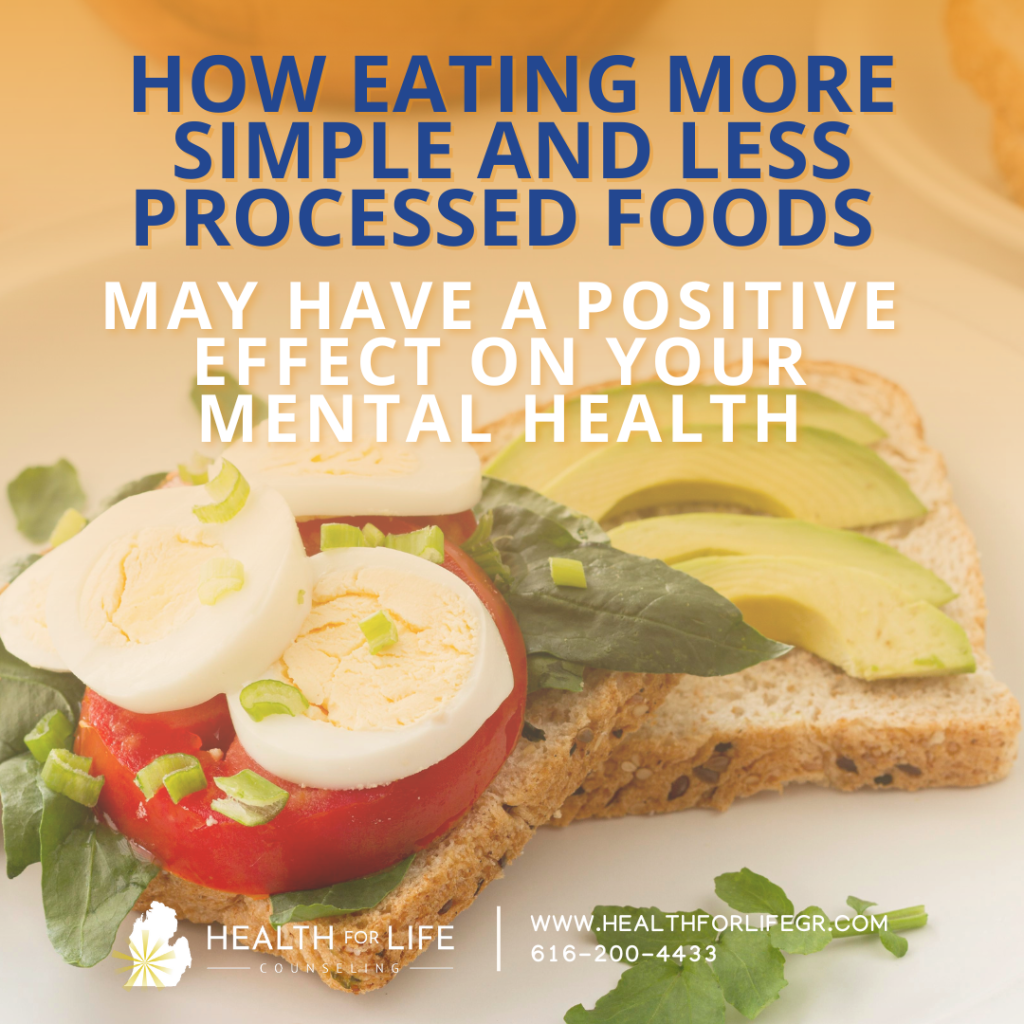
When you’re feeling anxious, busy, foggy, low, or emotionally drained, food choices often become about getting through the day. And that makes sense. After all, convenience foods are designed to be easy, comforting, and available when your brain and body feel depleted.
But research keeps pointing to the same pattern: the more your diet relies on highly processed foods, the more likely you are to report symptoms like low mood, irritability, and anxiety (Lane et al., 2022).
Of course, food alone can’t be the cause of mental health symptoms. But food is indeed one piece of your worsened condition – not because you need a perfect diet, but because your brain and nervous system run on what you give them.
However, you don’t need to give yourself extreme restrictions to feel a difference. Even reducing the amount of processed foods can support your nervous system. In this article, we’ll explain how.
What are “whole foods” and why do they matter
“Whole foods” are pretty much what they sound like: foods that are still whole. They look close to how they came from the earth, the tree, or the animal, with very little done to them. This means they’re either unprocessed or have undergone only small changes so that they’re edible.
So instead of something that’s been broken down, reshaped, and rebuilt in a factory, it’s something you can still recognize as itself. An apple is an apple. Oats are oats. Eggs are eggs. Beans are beans. Even frozen vegetables usually count, because they’re still the same, “real food” – just chilled to last longer.
On the other end of the spectrum are ultra-processed foods: packaged products made with industrial ingredients and additives (flavorings, emulsifiers, sweeteners, colorings). These are things you wouldn’t typically use in home cooking. And these are also the very things that can lead to ups and downs in both your body and mind.
Whole foods matter because they tend to be richer in fiber, vitamins, minerals, and protein. And these nutrients are important because that’s what helps your brain and body regulate energy, sleep, attention, and mood.
How processed foods can affect mood and anxiety
When you eat a lot of highly processed foods, it can show up in your mental health in a few ways. Even though it’s hard to assume food is the cause when you experience symptoms like low mood, irritability, brain fog, and restless energy, it may be your body responding to unstable fuel.
Research keeps finding a consistent association between food and mental health. For instance, high ultra-processed food intake among adults is linked with higher symptoms of depression, while processed food intakes are associated with lower depression (Gheranti et al., 2025). Importantly, improving overall diet quality reduced symptoms in individuals diagnosed with major depression (Jacka et al., 2017).
The thing is that when foods digest very quickly (like packaged snacks, sugary drinks, and refined carbs), you can get a fast rise in energy followed by a sharper drop. Usually, this drop, or “crash,” feels like jitteriness, irritability, fatigue, and a racing mind. These sensations are almost similar to anxiety. In addition to this, ultra-processed foods also tend to be lower in fiber, protein, and important nutrients, which means your brain may be trying to spend energy regulating your mood without steady fuel.
Processed foods can also affect your gut-brain connection. The gut, in fact, is also known as the “second brain.” Your digestive system and your brain are in constant communication, and stress can change digestion just as digestion can affect how stressed you feel. When most of your meals are low in fiber and variety, your gut may not get the “supporting ingredients” it needs to stay balanced. As a result, it may affect digestion, inflammation, stress hormones, and neurotransmitter activity.
Signs your eating habits may be affecting your mental health
Food usually isn’t the only reason you feel anxious or low. But it can be a background factor that makes your nervous system more reactive and your mood harder to stabilize.
Here are some signs your eating habits may be playing a role in your mental health symptoms:
- Your mood feels noticeably worse on days when meals are mostly packaged snacks or fast food.
- You feel frequent “crashes” (fatigue, brain fog, irritability) between meals.
- You rely on sugar, energy drinks, or caffeine just to function throughout the day.
- You feel more anxious when you’re hungry and calmer only right after eating – then the anxiety returns.
- Sleep feels lighter or more disrupted after late-night snacking or high-sugar foods.
- You crave highly processed foods most when you’re stressed, lonely, or overwhelmed.
- You plan to start eating healthy every other day but feel stuck in a cycle that increases shame or self-criticism.
What you can do to eat less processed foods
If a few of the signs above sound familiar, chances are that your nervous system is using food as a quick regulator. When you’re tired or stressed, eating healthier can feel like one more impossible task.
So let’s make this realistic and take a look at a few practical ways you can reduce processed foods and support your mood, energy, and anxiety:
- Pick one whole food a day
Add one whole-food item to what you already eat most days. It can be just a single fruit, nuts, a handful of baby carrots, a boiled egg, or a side salad.
- Build one steady meal you can repeat
What’s even better than a single whole ingredient is to have a “default” meal. When you have one steady option, your day has less decision fatigue, and you’re less likely to end up in the snack-crash cycle. This could be something like:
-
- Eggs + toast + fruit
- Oats + yogurt + berries/nuts
- Rice or potatoes + chicken/beans + vegetables
- Focus on protein and fiber each time you eat
You don’t need macros or rules. Just notice how meals that include some protein and fiber tend to keep your energy and mood levels more stable. On the other hand, “blood sugar swings” that are common with processed foods feel a lot like anxiety.
- Make one swap in your snacks or drinks first
When you’re starving, your brain will choose fast comfort. That’s why you should have a whole snack ready – nuts, cheese, a banana, or yogurt will buy you some time to make a better next choice.
What to do if you rely on food to cope emotionally
In a large U.S. study of adults, about 1 in 5 people reported that they often eat in response to feeling upset or stressed (Elran Barak et al., 2021). So if you rely on food to cope emotionally, you’re far from alone. It’s a common way for a nervous system to reach for relief and usually means food has become one of your quickest regulation tools.
It’s predictable. It’s available. And it changes how you feel fast — even if the relief doesn’t last long.
That’s why it’s hard to just stop. In the moment, your brain is choosing between discomfort and relief, not between broccoli and chips.
Before your nervous system starts reaching for relief, try to notice your patterns: Do cravings show up when you’re overwhelmed, lonely, tired, or hungry? Try to pause a bit before you eat, even for 30 seconds, and take a few slow breaths or drink a glass of water.
If you still want the food, you can have it, but you intentionally – that’s what makes a difference. That way, you’ll build enough awareness that food isn’t the only tool your nervous system has to feel okay.
How counseling can support you
Sometimes nutrition is not the main problem, but the place where stress shows up. The good thing is that it can be informative – if you notice that food has become one of the main ways you cope, it’s a sign your nervous system is asking for more support.
Counseling is an efficient way to work with what’s underneath your eating habits: chronic overwhelm, anxiety, burnout, loneliness, perfectionism, trauma history, or low self-worth.
At Health for Life Counseling, we use a holistic, integrative approach to help you understand what your nervous system is doing, why certain habits stick, and how to build realistic routines that support mood, sleep, and stress resilience. Our licensed therapists are willing to help you build practical tools for regulation so you don’t escape from your uncomfortable emotions with binge eating or constant snacking. We’ll focus on skills that help you pause, regulate, and respond with more choice.
Depending on your needs, therapy may include evidence-based approaches like EMDR Therapy, Trauma Informed Counseling, and much more, along with mind-body strategies that support long-term nervous system stability. Most importantly, we’ll meet you where you are and move at a pace that feels safe.
Reach out to us in our offices at Grand Rapids, Ada, or the Northview Neighborhood, or work with our counselors online from anywhere in Michigan. We also work with many insurance plans, including Aetna, ASR, Cofinity, Meritain Health, Optum, and others.

