
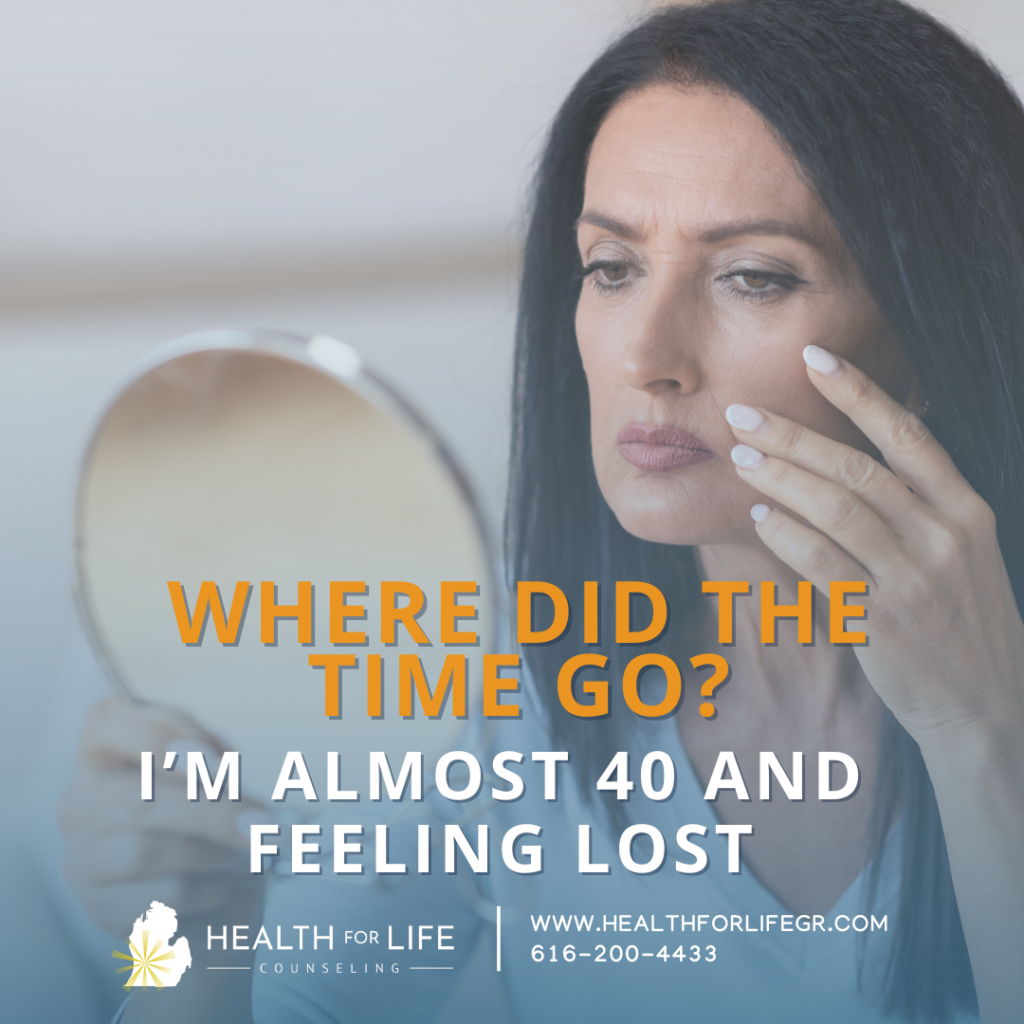
Sometimes 40 starts announcing itself before your birthday ever arrives.
You may notice it in small, simple moments. A photo from ten years ago. A friend’s child getting older. A parent needing more help. A career choice that no longer feels temporary. Or even a casual morning when you realize you are not as endlessly flexible as you used to be.
All this can make you wonder where the time went, whether you made the right choices, or why you don’t feel more certain by now when you’re almost 40.
This can feel confusing because almost 40 is not the same as being 20 or 30. At least, you’re not panicking about becoming an adult anymore. Still, it’s natural to face existential questions and ask yourself if that’s the life you wanted. At this stage of life, it’s natural to look at what you have outgrown, what still matters, and what kind of life you want to keep building from here.
In this article, we’ll talk about why almost 40 can feel so emotional, why it can bring up questions about time, purpose, relationships, and identity, and how counseling can help you make sense of this stage.
Why almost 40 can feel like a turning point
Many people feel like life really begins when you reach 40. In some ways, that can be a hopeful thought because it means the first part of life is full of learning, mistakes, experiments, and becoming, while the next part can be more intentional and self-aware.
Still, turning 40 can feel scary before you realize you’re free.
People who reach the age of 40 often begin to perceive time in a different way. One reason for this is that people in their 40s are more aware of their bodies, their health, relationships, career, family responsibilities, and the fact that choices have consequences. Things around 40 feel more immediate, and whenever you’re facing a challenge, it’s hard to convince yourself that you’ll “figure it out later.”
Even studies show that midlife is a specific developmental period that involves balancing gains and losses, connecting earlier and later parts of life, and often “bridging generations” through responsibilities toward children, aging parents, partners, work, and community (Infurna et al., 2020).
Research also shows that this stage is emotionally complex, too. In fact, sometimes people even call it the “unhappiest period” just because happiness in the 40s is U-shaped. What researchers call a U-shaped pattern of well-being (Blanchflower, 2020) means that happiness tends to be higher in younger adulthood, dip around midlife, and then rise again later in life. This, in turn, suggests that this stage can come with a specific kind of emotional pressure, where the gap between what you hoped for and what life actually looks like becomes harder to ignore.
Generativity vs. stagnation: what Erikson’s theory says about your 40s
In psychology, when we try to understand why certain ages feel emotionally loaded, we often look at Erik Erikson’s stages of development. Erikson was a developmental psychologist and psychoanalyst who believed that human growth doesn’t stop after childhood. Instead, each stage of life brings a different problem to be solved that is central to this stage.
For the 40s and middle adulthood, this central “challenge” is generativity vs. stagnation.
In Erikson’s theory, generativity means feeling that your life is connected to something meaningful beyond just getting through the day. For some people, this meaningful thing could be raising children, building meaningful work, caring for aging parents, creating something, supporting people, or passing on what they have learned.
The other side of this challenge is stagnation, which feels like being stuck, disconnected from purpose, or unsure whether what you do actually matters. If you’re facing what Erikson calls stagnation, you may be busy, responsible, and functioning, but still feel like your life has become repetitive or emotionally flat.
But the hopeful part is that stagnation is not a permanent state. Sometimes, noticing that your life feels disconnected is the first sign that something in you is ready to grow in a meaningful direction.
Underneath the “where did the time go?” feeling
The strange thing about approaching 40 is that the emotion often shows up before you fully understand what it is. In general, you don’t suddenly wake up thinking, “I am scared of aging.” Instead, you notice smaller changes, such as a sudden sadness when you think of old times or irritation when someone asks about the future.
Here are some of the common reasons why this feeling can show up:
- You are grieving time that passed – Even if you don’t really regret your life, you may still feel sadness about how quickly certain years went by. It’s natural to miss younger versions of yourself, earlier dreams, or old friendships.
- You are noticing paths you did not take – Around 40, it is common to think about the career, relationship, family, city, or version of yourself that could have existed. In fact, classic research on missed opportunities in midlife shows that it is common for people to imagine alternative versions of life, especially around relationships, education, work, and family (Landman et al., 1995).
- Fear of stagnation – If your days feel repetitive, predictable, or emotionally flat, 40 can make that harder to ignore. You may start wondering whether you are truly living or simply maintaining what you built. That’s exactly what Erikson called “stagnation” which is a normal part of the developmental challenge of midlife.
- Body and health awareness – When you reach your 40s, it’s easier to notice that your energy, sleep, health, appearance, and physical limits are changing. You may not recover as quickly as you used to and start thinking about health in a more serious way. This can bring anxiety, grief, or urgency.
- Relationship and family pressure – This stage often brings questions about marriage, divorce, parenting, not parenting, aging parents, loneliness, or changing friendships. You may feel responsible for many people and wonder at the same time who is holding you.
What you can do when turning 40 feels overwhelming
If turning 40 feels overwhelming, you don’t have to force yourself to stay positive or pretend it is just a number. Sometimes, the most helpful thing is to slow down and listen to what this stage of life is trying to show you.
- Prioritize self-care – You don’t need a complete lifestyle transformation to feel like you’re taking care of yourself. It can start with the basics, such as getting enough rest, moving your body, and eating in a way to support your energy. Taking care of yourself is a way to protect the life you are still building in your 40s.
- Separate your timeline from other people’s timelines – One of the most painful things in the 40s is comparison with other people. That’s why it’s important to separate culture from your values. Try to remind yourself that someone else’s timeline is not proof that you are behind. Yes, your life may have taken a different route, but that doesn’t make it less meaningful.
- Look for growth, not total reinvention – When life feels stuck, it can be tempting to think you need to change everything. But growth doesn’t always require significant changes. Sometimes it begins with one honest conversation, one new habit, or one area of life where you stop pretending everything is fine.
- Consider counseling – If the anxiety about turning 40 feels too hard to carry alone, counseling can help you sort through it. A professional therapist can help you explore what feels unfinished, grieve what has changed, reconnect with your values, and make grounded choices about what comes next.
Explore counseling support in Michigan
If you’re reaching 40 and notice you feel lost, stuck, or unsure what comes next, you don’t have to figure it out alone. Maybe something inside you is asking for more support than you’ve had before.
At Health for Life Counseling, our licensed therapists and counselors help people deal with life transitions, burnout, grief, relationship stress, anxiety, identity questions, and the emotional pressure that can come with midlife. Counseling is a safe space where you can slow down, understand what feels confusing, and make choices from clarity rather than fear or regret.
Depending on your needs, your therapist may integrate approaches like EMDR, DBT skills, trauma-informed counseling, ACT, and mind-body strategies to help you feel more grounded in your body and more connected to what matters when you’re almost 40.
You can meet with us in person in Grand Rapids, Ada, and the Northview Neighborhood, or choose online counseling from anywhere in Michigan. We accept many insurance plans, including Optum, Aetna, Meritain Health, ASR, Cofinity, Priority Health, UMR, and more.

