
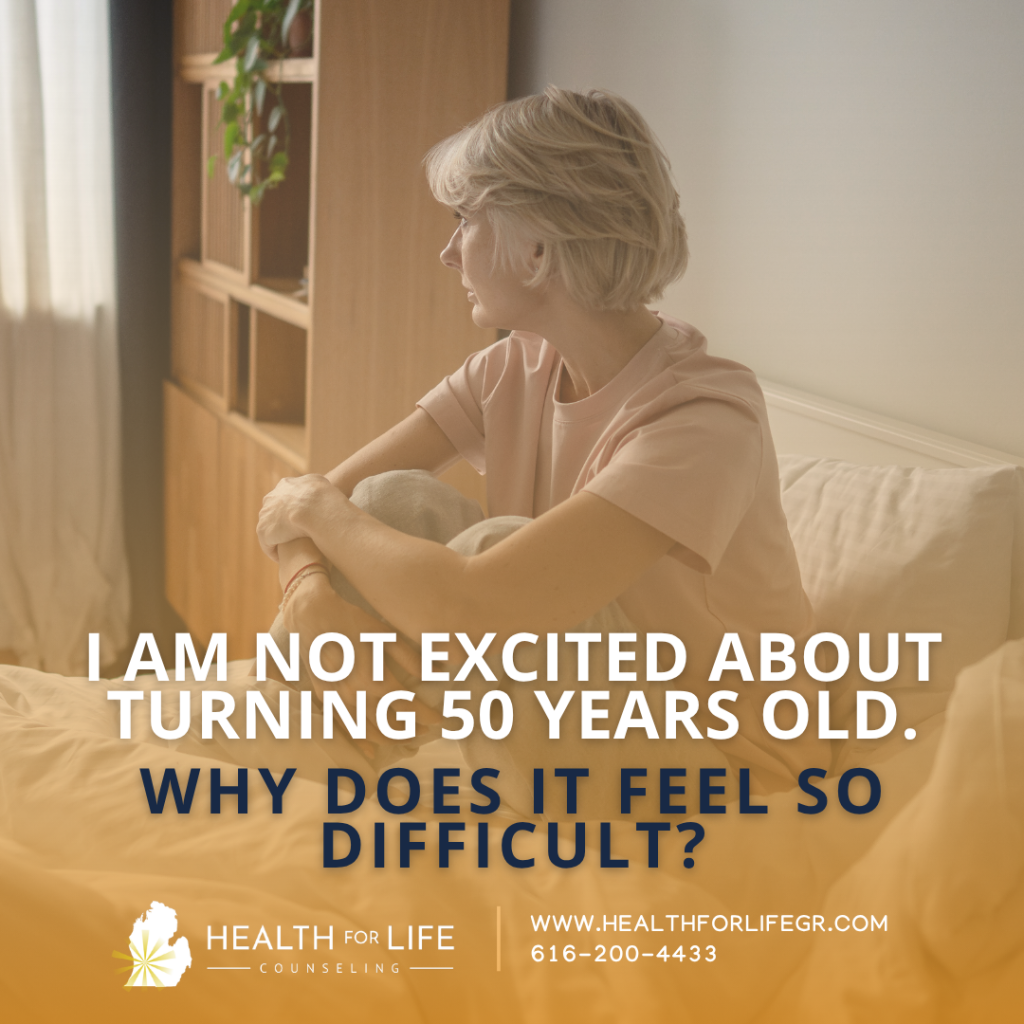
People often describe turning 50 as something you should celebrate. Your friends may make jokes about the “big five-oh,” your family may want to organize a party, and someone will probably tell you that age is only a number.
Either way, one thing is for sure: Turning 50 is a big milestone. And once you reach that age, it’s hard not to look back and wonder where the time went.
Perhaps 50 sounds much older than you feel. Maybe the birthday is making you think about your health, appearance, career, relationships, or everything you imagined you would have by this age. At the same time, your body is also changing, your parents may be getting older, or your children may need you less than they once did.
That’s why turning 50 sometimes naturally brings sadness, uncertainty, or even fear about what comes next, even if you have a lot in your life to appreciate.
In this article, we’ll discuss why this milestone can feel emotionally significant, what Erik Erikson’s theory and recent research tell us about this stage, and how counseling can help.
Reasons you may not feel excited about turning 50
Chronologically, nothing changes overnight. Even if you just turned 50, there’s no way you are fundamentally different the morning after your birthday. Still, turning 50 can make several changes that have been happening gradually in your life feel more real.
Midlife is often described as the crossroads of youth and old age, a period when people experience growth and loss together (Lachman et al., 2015). Middle-aged people play a central role in the lives of those who are younger and older at home, and taking on more responsibility isn’t always exciting.
Here are some more reasons you may not feel excited about turning 50:
- Society associates 50 with getting “older” – In our culture, we often think of certain numbers as a threshold when you officially become “older.” Even though you may not feel old, suddenly other people and cultural messages place you in that category. Research shows that middle-aged and older adults often feel younger than their chronological age (Wettstein et al., 2023), which can make turning 50 feel disconnected from how you see yourself.
- Time suddenly feels more limited – Once you reach 50, the goals you always had in mind to pursue “someday” can start to feel more urgent. It’s easy to think about missed opportunities or wonder whether you still have enough time to change careers, find a relationship, travel, or create the kind of life you want.
- You are worried about aging and health – At the age of 50, changes in energy, sleep, appearance, physical ability, or health are more common than before. Research suggests that middle-aged adults become more aware of changes they associate with getting older, although they may notice both gains and losses (Wettstein et al., 2022).
- You miss an earlier version of yourself – Emotionally, you may miss who you were when life felt more open, and you had fewer responsibilities. Even if you would not actually want to return to that period, turning 50 can bring grief for having more freedom, energy, confidence, or possibilities.
What Erikson’s theory says about turning 50
One of the most influential theories of human development in psychology was proposed by Erik Erikson, a German-American psychologist who believed that people continue developing throughout their entire lives. He divided the lifespan into 8 stages and described middle adulthood as the stage of generativity versus stagnation.
This means that people between ages 40 and 65 experience either generativity, which means feeling that you are contributing to something meaningful that will continue beyond you, or stagnation — feeling stuck, disconnected, or unsure whether your life is growing in a meaningful direction.
While human development doesn’t follow a strict calendar, based on this theory and developmental research, people often connect middle age to questions about purpose, contribution, and what you will leave behind. Therefore, as you turn 50, it’s natural to begin asking yourself what you have contributed, what you will leave behind, and whether the life you built still reflects your values.
Recent research mostly supports Erikson’s ideas. For example, a longitudinal study found that people who believed they had fallen short of the contribution they expected to make reported lower life satisfaction (Grossman & Gruenewald, 2020). Still, studies also show that there is no single way people are supposed to find meaning at that age, and there are individual differences in how generativity develops over time (Reinilä et al., 2023).
Does turning 50 mean your best years are behind you?
Nowadays, social media is full of phrases like “Fifty is the new forty,” or “The best is yet to come.” However, when you’re afraid of turning 50, these phrases can create just another expectation — that you’re supposed to accept aging and then feel enthusiastic about it.
In reality, nobody can promise your best years are still ahead. But turning 50 doesn’t automatically mean they are behind you either. Yes, it’s true that some opportunities are harder to pursue. Yes, your health requires more attention than before, and parts of your earlier life have actually ended. Nevertheless, there is no reason to think that turning 50 is the end of the most enjoyable or meaningful part of your life.
In fact, studies show that for some people, 50 is the first time they have enough experience to fully understand themselves. For instance, in a study that followed adults for more than 10 years, older age was associated with more positive emotional well-being and emotional stability (Carstensen et al., 2011).
This means that your best years after 50 simply look different from the best years in your 20s or 30s. There may be fewer first-time experiences, but one might develop more meaningful relationships or find the way to change something that has not felt right for a long time.
What to do if you are not excited about turning 50
Regardless of your current feelings about turning 50, you don’t have to force yourself to feel grateful or repeat positive phrases until you believe them. The best thing you can do is to understand what this milestone means to you and how you can respond to your concerns.
For example, if your main concern is health, you may need reliable medical information rather than imagining every possible future problem. If it is regret, you should try to separate things that really can’t change from what is still possible. If you feel stuck, consider whether that feeling comes from your current circumstances, other people’s expectations, or assumptions you have absorbed from culture about aging.
One more thing that can help you is just to let go of the overwhelming question “What have I done with my life?” and replace it with smaller questions, such as:
- What still matters to me?
- Which parts of my current life do I want to protect?
- What no longer fits who I am?
- Where do I want to invest my time and attention now?
- What would I like to contribute to other people?
Don’t have an expectation to answer all these existential questions at once. Give yourself time and try to accept the fact that it’s important and natural to allow your priorities to change.
How counseling can help when turning 50 feels difficult
Still, if you notice that the thoughts and feelings related to turning 50 feel like too much to handle on your own, counseling could be a good idea.
You do not need to be in crisis or have a clear explanation for why turning 50 is affecting your mood or well-being. If you notice that the idea of turning 50 makes you feel anxious, regretful, stuck, or unsure of what comes next, you should know that counseling can support you in processing these feelings and understanding why this milestone is affecting your quality of life.
Counseling gives you a place to admit that you are afraid of getting older, disappointed with how parts of your life have turned out, or uncertain about what comes next. Depending on your needs, you may benefit from different therapy approaches.
During individual counseling, you may explore grief about change, fear about the future, unresolved regret, changing relationships, or beliefs about what someone should have achieved by 50. People often choose Acceptance and Commitment Therapy as well, which can help you accept the parts of aging that you can’t control while focusing more intentionally on what still matters to you. And if thoughts about getting older, your health, or the future have developed into persistent worry, anxiety counseling may also help you respond to these thoughts in healthier ways.
Find counseling support for life transitions in Grand Rapids
At Health for Life Counseling, our licensed therapists provide counseling for life transitions and individual counseling adapted to your needs. Your professional therapist can help you explore concerns about aging, changes in your identity or family role, dissatisfaction with work or relationships, and fears about how much time you have left to make meaningful changes.
You can meet with our counselors in person in Grand Rapids, Ada, or the Northview Neighborhood, and we also offer online counseling throughout Michigan. Before scheduling your first session, you can review our available payment and insurance options, which may make professional support more accessible.

