
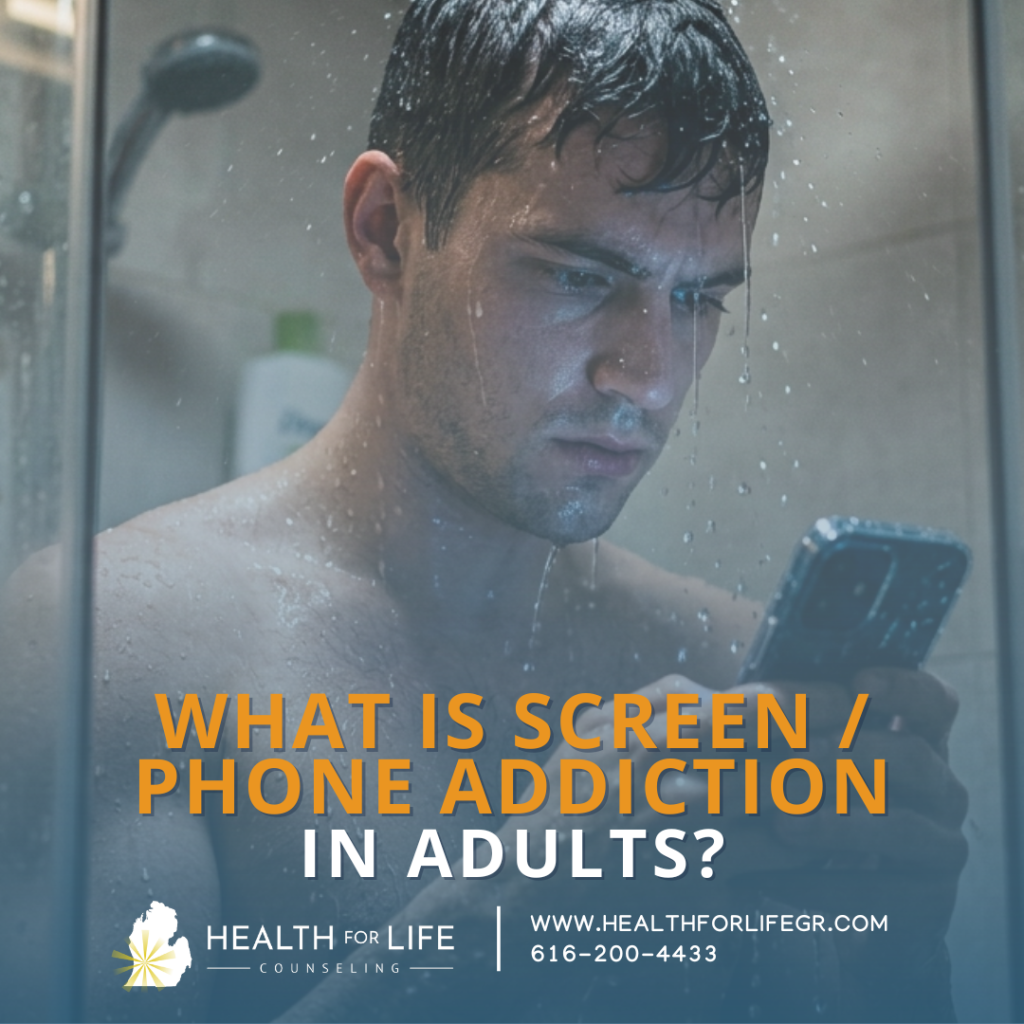
Most adults don’t think of themselves as “addicted” to their phone. They think it is just work. It is just staying in touch. Or it is just how life is now.
Maybe you pick up your phone to answer one message, and suddenly, 30 minutes are gone. Maybe you scroll when you feel tired. Maybe you feel more anxious when you cannot check notifications. And maybe part of you hates how automatic it feels, but you also don’t feel you have the power to stop this loop.
If reading makes this feel uncomfortable, you need to know that you’re far from being alone. Pew Research Center found that 41% of U.S. adults say they are online almost constantly. And it’s not surprising considering that phones and apps are designed to pull your attention, especially when you’re stressed, bored, lonely, or overwhelmed.
In this article, you will learn what phone or screen addiction can look like in adults, how it can affect mood and sleep, why it is so hard to put the phone down even when you want to, and what realistic ways there are to break this habit.
What is screen addiction and where does it come from?
In mental health research, “phone addiction” is often described as problematic smartphone use, which is defined “as the inability to control the time spent on smartphones, which has long-term negative impacts on daily life” (Navaz, 2023). In simple terms, it’s a pattern of uncontrolled phone use that starts interfering with daily life and well-being, like sleep, focus, relationships, or mood.
While you may commonly hear screen or phone addiction, it’s important to clarify that it’s not an official mental health diagnosis in the same way as depression or PTSD is.
In practice, you may be using your phone for work, parenting, and everyday life – and it’s normal. The problem isn’t that you use it. The problem is when it becomes compulsive or automatic, and you keep doing it even when it’s hurting your health.
So where does problematic phone use come from?
When being connected becomes the default, it makes sense that your brain starts treating your phone like a safety object, a stress reliever, and a distraction all at once. Phones give us simple rewards, social reassurance, and endless novelty. All this quickly increases dopamine, and as a result, our brains associate smartphone use with relief and quick reward. That is why your brain starts reaching for it automatically, especially when you feel even a little bored, stressed, lonely, or unsure.
A big part of this is the reward system. Every time you get a notification, a message, a like, or a new piece of interesting content, your brain gets a small hit of reward. Research describes these as digital social rewards and shows they can increase how strongly we respond to these rewards (Want & Wang, 2025).
Not surprisingly, if your phone helps you avoid difficult feelings, feel connected, or feel in control for a moment, your nervous system learns that the phone equals relief.
Signs your screen use is more serious than it seems
It is normal to use your phone a lot. Most adults have to. However, there’s a fine line between just using a phone by your choice and feeling like your phone is using you.
That’s why it’s important to recognize the signs that using a smartphone is becoming a behavioral addiction, such as gaming and gambling. The World Health Organization describes these issues in terms of loss of control and continuing the behavior even when it causes harm. Research on problematic smartphone use uses similar ideas, even if the label addiction is debated (Busch & McCarthy, 2021).
Here are signs your screen use may be more serious than it seems:
- Loss of control – You plan to check your phone for a minute, but it turns into longer sessions, and stopping feels harder than it should.
- Priority shift – Your phone starts to come before sleep, work, conversations, hobbies, or basic self-care.
- Neglecting negative consequences – You keep using your phone in the same way even when you notice it negatively affects your mood, focus, relationships, or health.
- Feelings of withdrawal – When you can’t check your phone, you feel unusually restless, anxious, irritable, or unsettled.
- Tolerance – What used to feel satisfying no longer works, so you need more scrolling, more checking, or more stimulation to feel the same relief.
- Using the phone to regulate emotions – You consider your phone a reliable coping tool to deal with stress and loneliness, avoid negative feelings, or shut your brain off.
- Functional impairment – Screen use is noticeably interfering with daily life, such as sleep, productivity, responsibilities, or relationships.
Why phones are so hard to put down
Let’s admit this: phones are not neutral tools anymore. They are built around meeting our basic psychological needs fast. Here are some of the reasons why it feels hard to put down your phone, even if you realize it is not good for you:
- They give your brain unpredictable rewards
Sometimes you check, and there is nothing. Sometimes there is a message, a funny video, a like, or a new piece of information. That unpredictability is powerful because it keeps your brain anticipating the next reward.
- They soothe discomfort fast (even if it is temporary)
For many adults, the phone has become a quick regulation tool. Studies show that looking for positive emotions and escaping from negative emotions are some of the most common reasons for problematic smartphone use (Stirnberg et al., 2024). Once our nervous system learns that it can quickly remove discomfort, we start to equate phones with safety.
- They offer a connection
When messages and updates feel constant, your brain can treat checking as a way to stay socially safe. Research links fear of missing out with more problematic smartphone use, especially when checking becomes a way to manage anxiety about being left out (Guan et al., 2023).
- They reduce silence
Many adults don’t realize how much emotional discomfort they carry until they try to sit in quiet. Phones become a way to avoid feelings that might come up in stillness.
How overusing screens can affect mental health
While overusing screens has plenty of negative effects for your physical health, they don’t automatically “cause” anxiety or depression. However, it can make your mental health harder to manage, especially when your phone becomes your main way to cope.
In fact, research does show meaningful associations between problematic smartphone use and mental health outcomes, including anxiety and depression symptoms (Want et al., 2025).
One of the biggest impacts it has is on sleep. Late-night scrolling easily keeps your brain alert, delays winding down, and makes sleep lighter. And sleep problems are associated with lowered mood and anxiety.
Screen overuse can also affect attention and stress levels. Constant switching between apps, notifications, and content trains your brain to stay on high alert. As a result, you may experience brain fog or feel reactive during the day.
And emotionally, too much screen time can create a loop of avoidance. You may get short-term relief from stress, loneliness, or boredom, but the feelings return stronger when you put the phone down.
What you can do right now (without a full digital detox)
You do not need to delete every app or disappear for a week to feel better. Most adults simply can’t do that anyway. But what you can do is to make your phone feel more like a tool again, not the place your brain automatically goes whenever life feels uncomfortable.
Here are a few quick fixes that may help right away:
- Reduce cues – Turn off non-essential notifications, move distracting apps off your home screen, and keep your phone out of reach during work blocks or conversations.
- Create phone-free boundaries – Try to spend the first 30 minutes after waking and the last 30 minutes before bed without a phone. This may sound minor, but it can efficiently protect your nervous system from overload.
- Batch checking – Instead of checking all day, check everything you need 2-4 times per day. That way, you’ll reduce the “always on” feeling.
- Replace with alternatives – If your phone is your main coping tool, you need to have alternative coping mechanisms ready, such as 2 minutes of breathing, a short walk or stretch, music, journaling, or even texting someone safe.
How counseling can help with screen/phone addiction
If your phone use has started to feel compulsive, chances are that you may be feeling frustrated with yourself, embarrassed, or confused about why something so small seems so hard to control. But when a habit starts interfering with sleep, focus, relationships, or your ability to feel present, it deserves support. And you don’t have to figure it out alone.
Counseling for phone addiction is efficient because it doesn’t just focus on the behavior itself. Instead, it focuses on the pattern underneath the behavior and aims to help you find the root cause. Studies show that psychological treatments can effectively reduce problematic smartphone use and time spent on the phone (Keller et al., 2021; Perez-Wiesner et al., 2025).
In therapy, you can work on identifying the moments you reach for the phone automatically, reducing the anxiety that shows up when you try to disconnect, and building boundaries that actually feel doable in real life.
At Health for Life Counseling, our licensed therapists take a holistic approach to help you understand what your nervous system is reaching for and build other ways to get that relief, so your phone stops being the main coping tool.
Depending on your needs, we may use various evidence-based approaches, such as EMDR Therapy, DBT skills training, and mind-body strategies to support attention, regulation, and healthier routines.
We offer in-person counseling in Grand Rapids, Ada, or the Northview Neighborhood, as well as online sessions anywhere in Michigan. Note that we also accept many insurance plans, including Optum, Aetna, Meritain, ASR, Cofinity, and more.

