
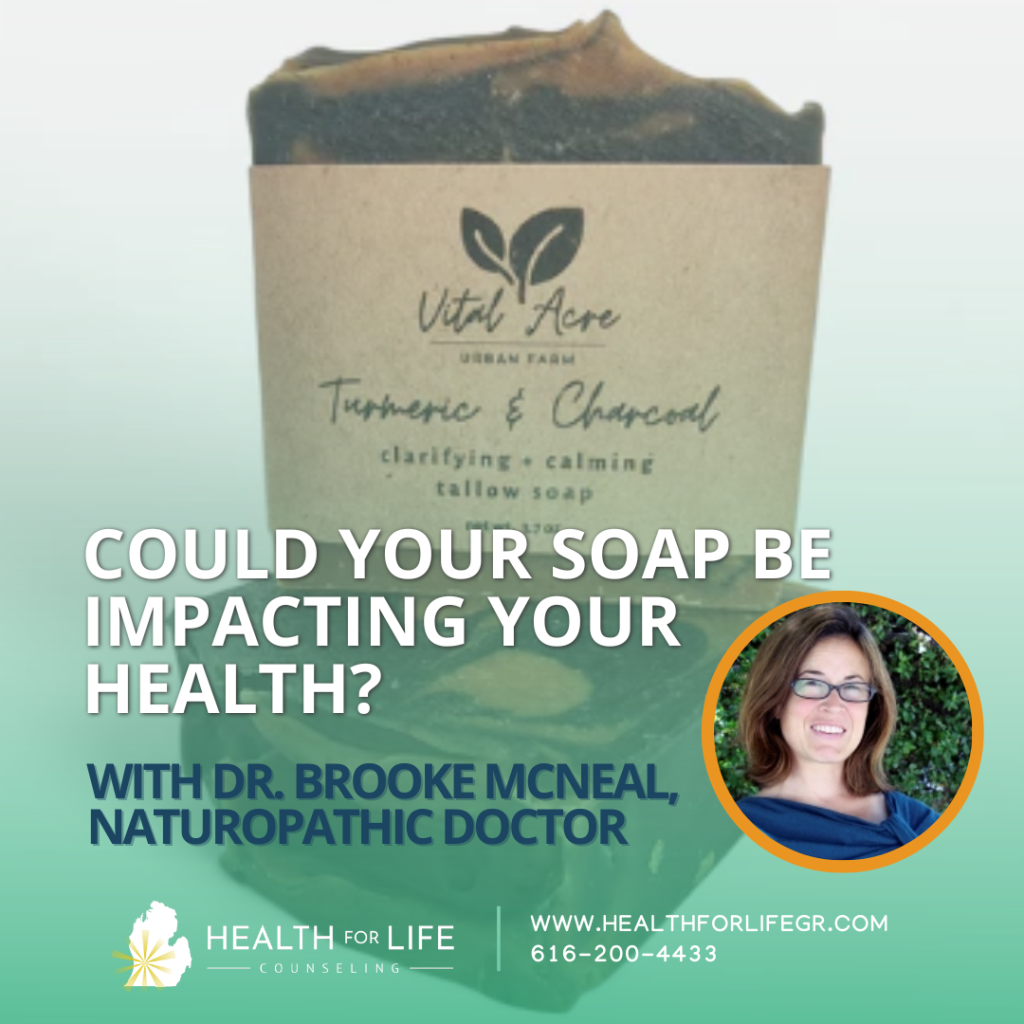
Most people don’t think twice about the soap sitting beside their sink or in their shower.
After all, it’s just soap, right?
Yet it may be one of the personal care products they use most frequently, and one of the products whose ingredients they know the least about.
As a naturopathic doctor, I’ve spent years helping patients identify the factors that may be contributing to their symptoms and overall health. We often look at nutrition, sleep, stress, movement, relationships, and environmental exposure. One area that’s still easy to overlook is the collection of personal care products we use every single day.
According to research published by the Environmental Working Group, “American women use an average of 12 personal care products that contain 168 different chemicals [daily],” while “men use an average of six personal care products that contain 85 different chemicals [daily].”
No single product is likely to make or break your health, but these exposures can add up over time.
In naturopathic medicine, we often discuss the concept of “total body burden”—the cumulative effect of the chemicals and substances we encounter through our environment, food, water, and personal care products.
So let’s take a closer look at something as simple as soap.
What’s Actually in Your Soap or Body Wash?
Many people are surprised to learn that not all products labeled as “soap” are actually soap in the traditional sense.
Many conventional body washes and cleansing bars are technically synthetic detergent products, often called syndets. These products may contain cleansing agents, preservatives, fragrances, dyes, and other ingredients designed to improve shelf life, texture, foaming, or scent.
Traditional soap, by contrast, is made through a process called saponification, where fats and oils are combined with an alkali to create soap. This method has been used for centuries and can produce a simple cleanser with a relatively short ingredient list.
Neither approach is inherently good or bad. Some people tolerate conventional cleansers without issue, while others find that heavily fragranced or highly detergent-based products leave their skin feeling dry, irritated, or tight after use.
Your Skin Is More Than a Barrier
Your skin is your body’s largest organ.
Its primary role is to protect you from the outside world, but it is not an impenetrable shield. Certain substances can be absorbed through the skin, and many ingredients applied to the skin can influence the skin’s microbiome, barrier function, and overall health.
Healthy skin acts as a resilient barrier, helping regulate moisture, protect against irritants, and support immune function. When that barrier is disrupted, it can contribute to dryness, irritation, inflammation, and increased sensitivity. In some people, this may be one piece of a larger picture that includes headaches, low mood, or brain fog. We’ll look at real patient cases later in this article where personal care products appeared to play a role.
Many conventional cleansers are formulated to strip away oils and leave skin feeling ‘squeaky clean.’ That sensation can be satisfying, but it usually means your natural protective oils have been removed. A good cleanser doesn’t need a big, foamy lather or that scrubbed‑bare feeling to be effective. If your skin feels soft and comfortable—not tight, itchy, or dry—10 to 15 minutes after washing, that’s a good sign your skin barrier is being supported rather than stripped.
Over time, this can contribute to a cycle of dryness, irritation, and dependence on increasingly intensive moisturizers.
For patients with sensitive skin, eczema, allergies, or chronic dryness, I often find that switching to a simpler cleanser, such as a traditional handmade soap, is worth considering.
We don’t need perfection to make meaningful changes. Rather, it’s to become a more informed consumer and choose products that align with your individual needs, values, and skin health goals.
Why Naturopathic Doctors Care About Environmental Exposures
One of the core principles of naturopathic medicine is to identify and remove obstacles to health.
When a patient comes into my office, I don’t just look at symptoms in isolation. I look at how nutrition, sleep, stress, movement, relationships, environmental exposures, and daily habits are working together.
Rarely is a single culprit responsible for a person’s health concerns. More often, health is influenced by the cumulative impact of many small inputs over time. Naturopathic doctors call this the total body burden: Every day, our bodies are exposed to substances from the food we eat, the air we breathe, the water we drink, and the products we use on our skin.
The good news is that we don’t need to achieve perfection to make meaningful changes.
Example Cases
As a naturopathic doctor, I often encourage patients to pay attention to how their body responds rather than assuming every product works equally well for every person.
Story 1: Migraines, Mood, and Lipstick
A 42‑year‑old woman, came in for near‑daily migraines and a low, depressed mood that had been present for several years. She was already eating well, exercising regularly, and taking prescribed medication as directed, but she kept having breakthrough headaches. They were worse in the late morning or early afternoon at work. She described feeling “foggy and numb” most days.
In a detailed review of her routine, one pattern stood out. Many of her migraines began within an hour or two of her getting ready for the day. She used a heavily fragranced foundation, perfume, and a long‑wear lipstick multiple times daily. At first, she was skeptical that her makeup could matter, but she agreed to try an experiment: for four weeks, she made just one small change. She replaced her usual lipstick with a simpler, unscented, organic formula and reduced the number of fragranced products she used at the same time.
Over the next month, she noticed that the frequency of her migraines dropped from near‑daily to one or two a week, and the remaining episodes were milder and easier to manage.
She also described feeling “more present” and less emotionally blunted on the days she skipped her old products altogether. Her medication and lifestyle hadn’t changed; the main variable was removing one repeated exposure from right under her nose.
For her, that small shift became one meaningful part of a broader, ongoing plan for migraine and mood support. Motivated by this improvement, she went on to do a whole body reset, taking a careful look at the ingredients in all of her personal care products.
Story 2: Brain Fog and Scented Soap
A 35‑year‑old parent came in looking for support for persistent brain fog. They described it as “walking around with cotton in my head.” They had difficulty focusing at work, slow word-finding, and feeling drained by the end of the day. Basic labs were unremarkable, and they were already paying attention to sleep and blood sugar balance, but the cognitive symptoms persisted.
During a discussion about their daily environment, they mentioned that they loved “fresh” scents and used a highly fragranced body wash, matching lotion, scented dryer sheets, and plug‑in air fresheners at home. They had never considered that these products might be relevant to how their brain felt. To them, they just made the house smell clean.
The plan was simple: for six weeks, they would switch to a fragrance‑free soap and laundry detergent, remove the plug‑ins, and limit additional scented products as much as possible. There were no other changes in their regimen during that period.
Within about two weeks, they reported that the late‑afternoon “wall” they usually hit at work was less intense. By the end of the trial, they noticed they were able to read and retain information more easily, and their evening headaches had become less frequent. Interestingly, when they briefly returned to their old scented body wash and plug‑ins for a weekend, the brain fog and headaches flared again within a day, which helped them connect the dots in a way that felt very tangible.
For this patient, removing synthetic fragrances from something as routine as soap wasn’t the only factor in their cognitive health, but it was a clear, repeatable lever they could control—and one that gave them a greater sense of agency over how they felt day to day.
Small, sustainable improvements can add up over time. Choosing a simpler soap, improving sleep habits, spending more time outdoors, eating more whole foods, or reducing chronic stress may each seem insignificant on their own. Together, they can help create an internal environment that better supports overall health and resilience.
This matters just as much for mental well‑being as it does for physical health. Chronic stress places significant demands on the body, and while personal care products are rarely the primary driver of mental health concerns, reducing unnecessary irritants and simplifying daily routines can remove one small source of strain and support a greater sense of ease.
Naturopathic medicine is, at its core, about working with the body rather than against it. Often that begins with the choices we make every day, including something as simple as the soap we use.
The Fragrance Question
One common concern I discuss with patients is fragrance.
The word “fragrance” on an ingredient label may represent dozens—or even hundreds—of individual compounds. Because fragrance formulations are considered proprietary, manufacturers are generally not required to disclose the specific ingredients used.
This lack of transparency makes it hard to know exactly what you’re being exposed to. Fragrance is one of the most common triggers for allergic contact dermatitis and skin irritation. For some people, fragranced products also seem to contribute to headaches, migraines, respiratory irritation, or increased chemical sensitivity.
Additionally, certain fragrance ingredients have raised concerns among researchers because of their potential effects on hormonal and environmental health. While science continues to evolve, many people choose to reduce unnecessary fragrance exposure as part of a broader effort to support overall wellness and minimize cumulative chemical burden.
Particularly those struggling with chronic skin issues, allergies, migraines, or chemical sensitivities may benefit from taking a closer look at the scented products they use daily.
Skin Health and Mental Well-Being
Soap is probably not the first thing that comes to mind when we think about mental health. The connection between skin health and emotional well‑being is stronger than many people realize.
Anyone who has struggled with eczema, acne, chronic irritation, itching, or sensitive skin understands how profoundly these conditions can affect confidence, comfort, and quality of life.
Research continues to highlight the close relationship between the nervous system, immune system, and skin. Stress can worsen skin conditions, and skin conditions can increase stress. It’s a two-way street.
While changing your soap is not a cure for anxiety, depression, or other mental health concerns, reducing unnecessary irritants and supporting overall skin health may help remove one source of chronic physical stress from the body.
There is also something to be said for creating simple daily rituals that support well-being. A calming shower, a thoughtfully chosen soap, and a few moments of intentional self-care can become part of a larger lifestyle approach that promotes resilience and balance.
Less Can Often Be More
One of the biggest misconceptions in the personal care industry is that more ingredients are always better.
In reality, many people benefit from simplifying their routines.
Instead of chasing the latest trend or filling their bathroom cabinets with countless products, I often encourage patients to focus on the basics:
- Gentle cleansing
- Adequate hydration
- Nourishing moisturization
- Sun protection
- Consistent healthy lifestyle habits
The same philosophy applies to soap.
A well-formulated soap doesn’t need a long list of synthetic additives to be effective. Remember, traditional soap-making methods have been used successfully for many generations! They work great, and the right recipe can smell absolutely wonderful, no chemicals needed!
Reading Ingredient Labels
You don’t need a chemistry degree to become a more informed consumer.
When evaluating a soap or body care product, ask yourself the following questions:
- Do I recognize most of these ingredients?
- Does the product contain synthetic dyes or fragrances?
- How does my skin feel after using it ?
- Does it leave my skin comfortable or tight and dry?
- Am I using this because it supports my skin, or because the marketing convinced me I need it?
The goal isn’t perfection.
It’s awareness.
Small changes made consistently over time often have a greater impact than dramatic changes that are difficult to maintain.
A Practical Approach
I don’t believe we need to live in fear of every ingredient we encounter. Modern life inevitably involves exposure to countless substances, and attempting to eliminate every potential concern is neither practical nor realistic.
Instead, I encourage people to focus on reducing exposures where it is easy and sustainable to do so.
Choosing simpler personal care products can be one of those opportunities. When we make thoughtful choices about what we put in and on our bodies, we support the body’s natural ability to maintain balance and health.
The Bottom Line
Soap may seem like a small thing, but small things add up.
The products we use every day become part of our environment, our routines, and ultimately our overall health picture.
If you’ve never looked closely at the ingredients in your soap, consider this your invitation to take a look. You may discover that a simpler approach is exactly what your skin — and perhaps your overall well-being — has been asking for all along.
About the Author
Dr. Brooke McNeal, ND, is a naturopathic doctor, regenerative farmer, and founder of Vital Acre Urban Farm. Through her soil-to-skin approach, she formulates farm-grown skincare using botanicals cultivated on her Florida farm. Learn more about her approach to healthy aging and farm-grown skincare at VitalAcreFarm.com.

