
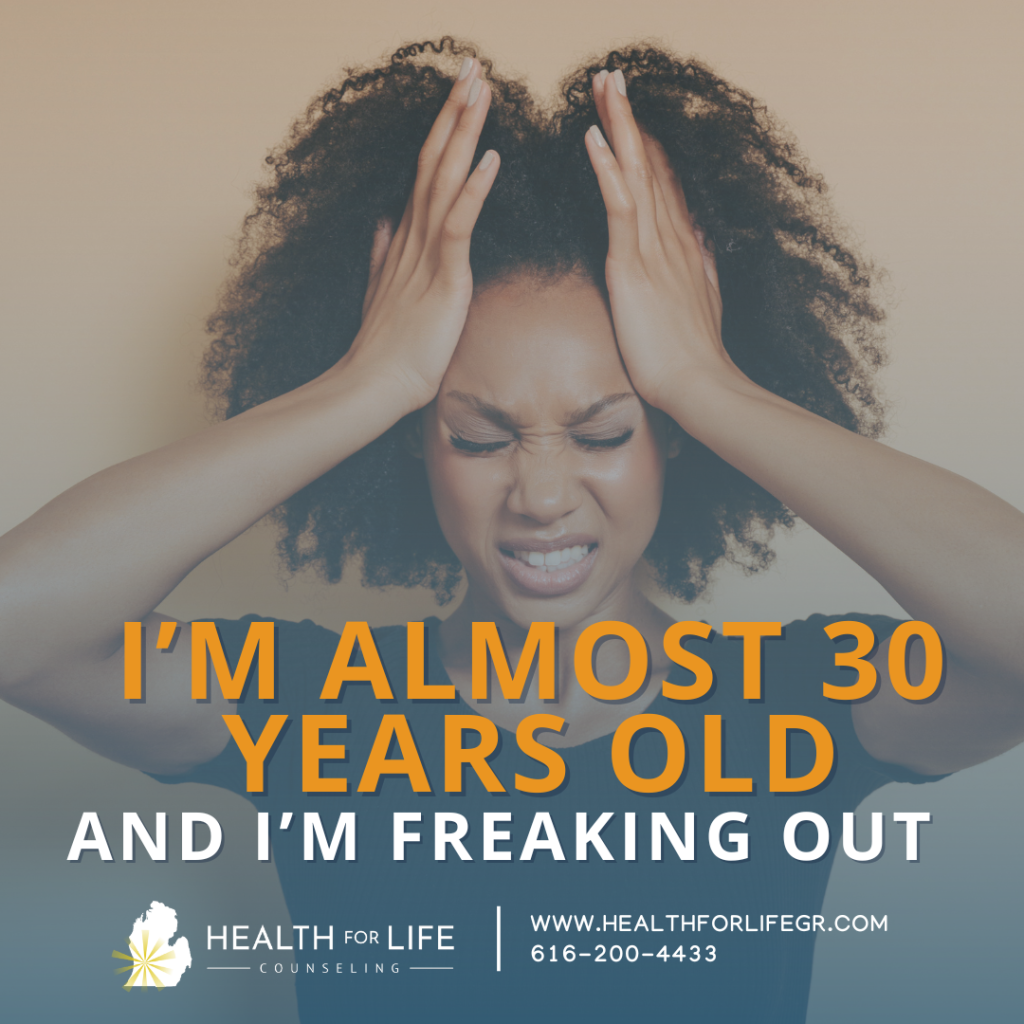
Turning 30 can make you look at your life through a new lens. Once you reach this age, it becomes easier to notice a gap between where you thought you would be and where you are now.
Maybe you have a job, relationships, goals, and a life that looks fine from the outside. But as 30 gets closer, a lot of people feel a pressure building, or an emotional burden even, to have everything figured out.
That pressure may make you ask yourself existential questions you were able to ignore before. Am I on the right path? Did I waste my 20s? What if I choose the wrong version of life? What if I never feel settled? What if everyone else is ahead?
As this age activates timeline thoughts, it’s harder for the nervous system to react to uncertainty. As a result, doubts that used to come and go start sticking around. Researchers are calling this phenomenon “quarter life crisis,” and it affects 40% to 77% of young adults worldwide (Robinson et al., 2025).
However, this kind of fear is often what happens when your mind is trying to make meaning, evaluate your choices, and seek stability at a new stage of life. In this article, you’ll learn why turning 30 can feel so intense, what’s underneath the panic, and what you can do to feel steadier.
Why turning 30 can feel scary
Our culture puts a lot of symbolic weight on turning 30. It is often treated like a line between being young and being an adult. While it’s expected in your 20s to explore, experiment, make mistakes, and keep your options open, at 30, many people feel pressure to solidify things and finally settle down.
Even if you don’t consciously believe in that timeline, you might still associate 30 with adulthood, stability, responsibility, commitment, marriage, children, career success, financial security, or finally knowing who you are. On the other hand, there’s your rational mind telling you 30 is just a number, a symbol, and there’s no rush to have everything figured out.
Still — however irrational it may feel to freak out about turning 30, there are real psychological reasons behind it. In particular, this age tends to combine high uncertainty with high perceived consequences, which is exactly the mix that makes the nervous system feel urgent.
First of all, humans are evolutionarily wired to treat stability and belonging as safety. So when a milestone like 30 makes you question whether you will be secure, your brain can read that uncertainty as a threat and push you toward urgency.
Another reason is that even if you’re not trying to have kids right now, many people still feel extra pressure around 30 for one simple reason: fertility starts to decline in the early 30s, and the decline becomes faster in the mid-30s. While for men, fertility doesn’t “drop off” at a single age, sperm parameters and testosterone levels also tend to start declining around the ages 30-35 (Martins da Silva & Anderson, 2022). That can make 30 feel like a symbolic “clock” in the background, even for people who don’t want kids right now.
Cognitively, your mind also activates evaluation mode. You start reviewing past choices, imagining future outcomes, and comparing yourself to other people your age more. That mental scanning can make everything feel more high-stakes than it actually is.
This is also reflected in quarter-life crisis research, where common themes include uncertainty about the future, negative self-evaluation, feeling stuck, and pressure around life direction and work (Hasyim et al., 2024).
Intimacy vs. Isolation: What Erikson’s theory says about your 30s
If this “almost 30” panic feels confusing, it can help to know that, based on classic psychology theories, it’s actually expected.
Erik Erikson, a famous developmental psychologist and psychoanalyst, believed that human development happens through different life stages, and each stage comes with a central emotional conflict. For young adulthood, that conflict is called intimacy vs. isolation.
This stage spans roughly from 19 to 40, and the main focus is learning how to form deep, honest, meaningful relationships without losing yourself. Erikson used the word “intimacy” to mean the ability to build close, mutual relationships where you can be known and still feel safe. While it includes romantic relationships, it’s not exclusive to romance and includes any type of deep connection that leads to a sense of belonging.
The other end of this conflict is “isolation.” And isolation does not always mean you are physically alone. You might have friends, coworkers, dates, or even a partner, yet still feel like nobody truly knows you. You might notice that closeness makes you uncomfortable, or you distract yourself whenever things get emotionally real. Isolation, in this sense, means feeling emotionally guarded, hard to reach, or like you are doing life on your own even when people are around you.
This, in turn, explains why turning 30 can intensify fear — as people move into adulthood, surface-level connections often stop feeling satisfying. Your system starts wanting something more stable: deeper belonging, a shared life, a few people you can genuinely lean on. If you do not have that yet, or if you have it but do not feel safe inside it, the nervous system can interpret that as a threat. It can trigger urgency, sadness, comparison, or a sense that you are falling behind.
What’s underneath the panic
When you’re close to 30, the panic rarely comes from the number itself. It usually comes from what the number activates inside you: loss, pressure, belonging, meaning, and uncertainty.
A 2025 study on quarter-life crisis highlights themes like confusion or uncertainty about the future, negative self-evaluation, and feeling sad, down, fearful, anxious, or worried (Robinson et al., 2025). Here are some of the most common reasons why people “freak out” in their 30s:
- Grief of leaving your 20s behind – Many of us associate 30s with a special kind of freedom — less commitment, more experimentation, mistakes, messy love, late nights, identity changes, and big dreams. As 30 approaches, it can feel like you are supposed to become more serious, stable, and certain. Thus, letting that go can feel like losing a version of yourself.
- Grief for the versions of life you imagined – Sometimes we grieve not just for what happened, but for what did not. There’s an idea in modern psychoanalysis about “unlived lives” — the selves you could have been, the relationships you might have chosen, the cities you didn’t move to, the careers you didn’t try. Adam Phillips writes about how much of adult life includes learning to live with what you did not become, which is especially relatable when 30 gets close.
- Fear of failure and fear of choosing wrong – This age can make decisions feel final. You may feel scared that one decision will close every other door, so the mind tries to find the “perfect” choice to avoid regret. This, in turn, creates paralysis and more anxiety.
- Meaning crisis – It’s common around 30 to realize you’ve been living by expectations rather than values. Maybe you are doing what is practical, but it does not feel meaningful. Work that once felt practical may now feel empty. That mismatch often shows up as a sense that you’re running out of time to change direction.
- Safety-system activation – Chronic stress makes everything feel urgent. And when your nervous system has been stressed for a long time, it becomes less tolerant of uncertainty. In anxiety research, uncertainty is a key driver of anticipatory threat (Grupe & Nitschke, 2013). That’s why everything starts to feel like a problem you must solve right now.
- The comparison trap – Social comparison is brutal at this age because peers appear to be settling down. When your brain is already scanning for proof that you are behind, it’s easier to notice other people’s achievements and “finished chapters” on social media, which feels like evidence. This, in turn, can intensify negative self-evaluation and sometimes even lead to depressive symptoms (Ahmad et al., 2024).
What you can do when you’re freaking out about turning 30
When the panic hits, and you feel like “freaking out,” what the brain actually wants immediately is certainty. That’s why it doesn’t really make sense to focus on solving your whole life right away. Instead, it’s important to calm your system enough to think clearly again.
The following simple strategies may help you deal with anxiety and feel calmer:
- Name what you’re actually afraid of. It’s not just “turning 30,” but something more specific, such as being alone, choosing wrong, wasting time, disappointing someone, or feeling stuck. When you have a specific answer, the panic becomes easier to work with.
- Don’t confuse cultural expectations with your values. There is the life you want, and there is the life you think you should want. Try to write down what matters to you in the next few years, even if it is messy or non-traditional.
- Don’t make global conclusions from temporary feelings. A hard week can make your whole future look hopeless. When your nervous system is stressed, your brain starts predicting from stress. That’s why you should remind yourself that you’re overwhelmed and you need support, rest, and a clearer next step.
- Choose one next step, not a life overhaul. You don’t need to (and you can’t) change your whole life immediately. What can help, though, is a single conversation, a small plan, a short list of priorities, or booking a counseling appointment. Your nervous system often just wants to feel you have a choice again.
How counseling can help you feel less lost before 30
Research shows that counseling can be an effective way to reduce anxiety and depression symptoms in young adults who often show up in their late 20s. For instance, a 2014 study assessed an identity-focused counseling intervention for emerging adults and found it was linked with lower identity distress and higher well-being (Meca et al., 2014). A 2025 randomized study also shows that a brief group counseling program centered on self-compassion and emotional awareness helped emerging adults reduce psychological distress and increase positive emotions (Karakasidou & Komninou, 2025).
This means that counseling can help you slow down the urgency, name what’s underneath it, and take next steps based on your real values, instead of irrational fear. That could be why many people are using counseling for self-development, instead of waiting until they feel completely burned out or in crisis.
In other words, therapy is not only for when something falls apart. It can be a place to get clarity at a turning point and build the emotional skills that help you feel steadier in the next chapter.
Explore counseling opportunities in Michigan
If turning 30 is bringing up anxiety, regret, relationship uncertainty, or a sense of being lost, you don’t have to carry it alone.
At Health for Life Counseling, our professional therapists support people who feel anxious, stuck, overwhelmed, or uncertain about their next chapter. During the sessions, they will guide you to understand the patterns underneath your stress and build practical tools for emotional regulation. Depending on your needs, support from your therapist may include anxiety counseling, trauma-informed counseling, EMDR therapy, Acceptance and Commitment therapy, Cognitive Processing therapy, or mind-body tools that help calm your nervous system when everything feels urgent.
You do not have to have a crisis to benefit from therapy. Sometimes, counseling is where you begin to hear yourself more clearly. If you’re in Grand Rapids, Ada, and the Northview Neighborhood, or anywhere in Michigan through online counseling, Health for Life Counseling can help you move through this transition with more clarity and compassion.

