
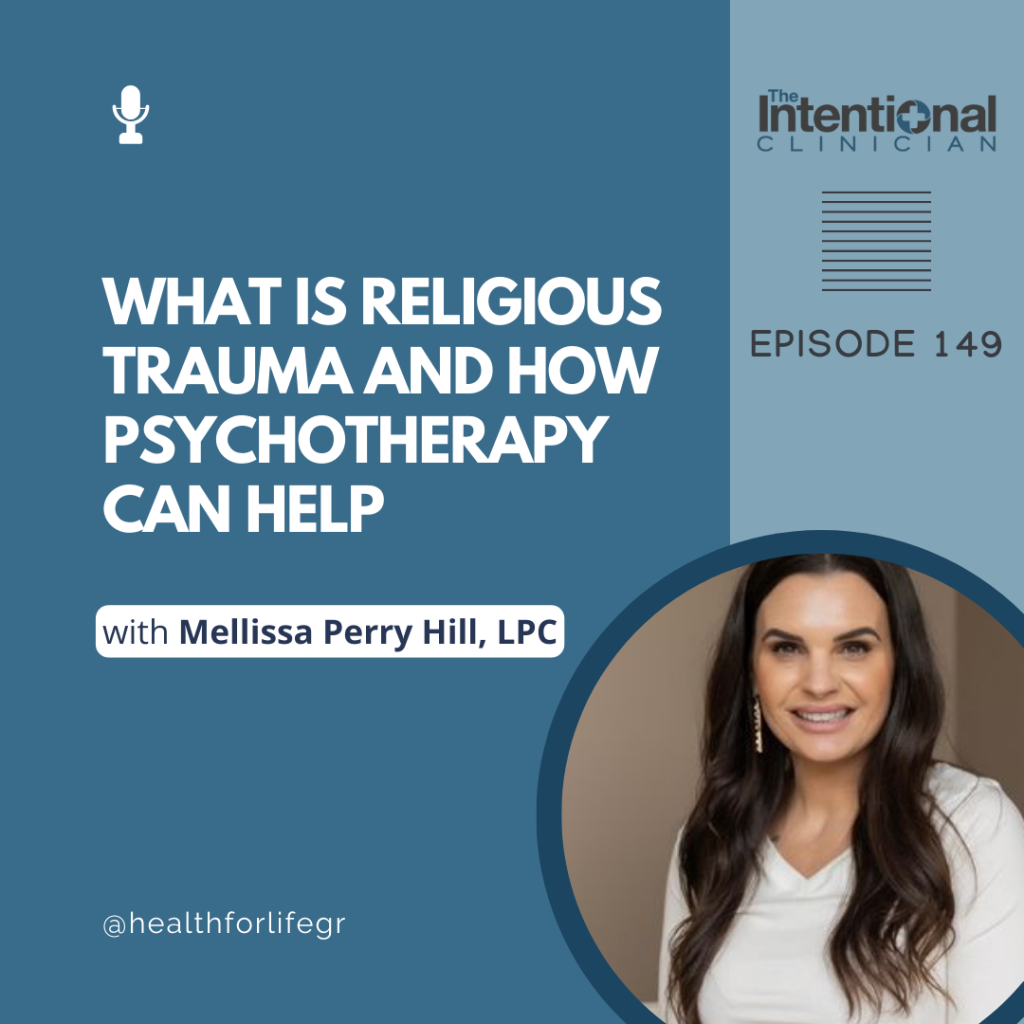
[Episode 149 of the Intentional Clinician Podcast]
In Episode 149 of the *Intentional Clinician Podcast*, Mellissa Perry Hill, LPC, joins host Paul Krauss, MA, LPC, to delve into the multifaceted topic of religious trauma. Together, they explore the emotional, cognitive, and social impacts of religious trauma, Mellissa’s personal journey of leaving Mormonism and the Church, and how psychotherapy can serve as a vital tool for healing. This episode addresses how individuals who have experienced religious trauma often feel isolated, disillusioned, or existentially lost after undergoing a faith transition. Mellissa provides valuable insights into how therapy can help these individuals reclaim their sense of self and navigate life transitions.
Mellissa Perry Hill’s Story and Expertise
Mellissa Perry Hill grew up in Southern California in a large family deeply involved in a high-control conservative religious environment. She attended Brigham Young University-Idaho, where she studied sociology and family studies. After spending a decade as a stay-at-home parent, her life took a transformative turn following her divorce and faith transition. This pivotal period led Mellissa to seek therapy for herself, marking the beginning of her journey toward becoming a therapist.
Over the next several years, Mellissa became an educator while pursuing her master’s degree in professional counseling at Grand Canyon University. Today, she specializes in guiding individuals through major life transitions—particularly faith transitions—helping them find healing in the present moment and build futures that align with their core values. Her clinical practice integrates evidence-based modalities like EMDR (Eye Movement Desensitization and Reprocessing), IFS (Internal Family Systems), and DBT (Dialectical Behavior Therapy) to address trauma, anxiety, depression, and identity shifts.
Religious Trauma Syndrome: Symptoms and Challenges
Religious trauma syndrome (RTS) is a form of psychological distress experienced by individuals leaving authoritarian or dogmatic religious environments. Symptoms often overlap with PTSD or complex PTSD (C-PTSD) and include anxiety, depression, guilt, shame, emotional numbness, dissociation, identity confusion, nightmares, and suicidal ideation[1][4][10]. RTS can also manifest socially as ruptures in family relationships or isolation from former communities[7]. Cognitive symptoms such as confusion and difficulty with decision-making are common due to years of indoctrination or suppression of critical thinking[4][10]. For many individuals navigating faith transitions, the loss of meaning or purpose can be particularly challenging[7].
Mellissa’s personal experiences with these dynamics inform her empathetic approach to therapy. Her practice provides a safe space for clients to process grief and anger while rebuilding their identities outside of high-control religious systems[2][5].
How Psychotherapy Helps Heal Religious Trauma
Psychotherapy offers effective tools for addressing the emotional wounds caused by religious trauma. Therapists like Mellissa Perry Hill use evidence-based approaches such as EMDR to process traumatic memories; DBT to develop emotional regulation skills; and IFS to help clients reconnect with their authentic selves[5][8]. These modalities empower individuals to navigate their faith transitions with greater clarity and resilience.
In addition to individual therapy sessions, Mellissa facilitates group therapy programs focused on faith transitions. These groups provide participants with skills in mindfulness, distress tolerance, emotional regulation, and interpersonal effectiveness—all tailored to the unique challenges posed by religious trauma[8]. Therapy helps clients redefine their values, integrate their experiences into a cohesive sense of self, and create lives aligned with their personal beliefs rather than imposed doctrines[2][5].
Religious trauma is a complex issue that affects individuals emotionally, cognitively, socially, and spiritually. Mellissa Perry Hill’s expertise in psychotherapy—combined with her lived experience—makes her uniquely equipped to guide those navigating faith transitions. Through individual therapy sessions and group programs, she offers hope and healing for those seeking to rebuild their lives after leaving high-control religious systems. Episode 149 of The Intentional Clinician Podcast serves as an insightful resource for understanding religious trauma and exploring how psychotherapy can facilitate recovery.
Sources
[1] What is Religious Trauma Syndrome? – Sabino Recovery https://www.sabinorecovery.com/what-is-religious-trauma-syndrome/
[2] Mellissa Perry Hill, Licensed Professional Counselor, Gilbert, AZ … https://www.psychologytoday.com/us/therapists/mellissa-perry-hill-gilbert-az/848150
[3] baroni.rows https://www.lingexp.uni-tuebingen.de/z2/Morphology/baroni.rows
[4] Religious trauma syndrome – Wikipedia https://en.wikipedia.org/wiki/Religious_trauma_syndrome
[5] Therapy for Religious Trauma and Faith Transitions https://inner-compass-counseling.com
[6] ME/2 – Bar Ilan NLP Lab https://nlp.biu.ac.il/~ravfogs/resources/embeddings-alignment/glove_vocab.250k.txt
[7] Religious Trauma Syndrome – Journey Free https://www.journeyfree.org/rts/
[8] DBT Based Faith Transition Therapy – Support Group in Gilbert, AZ … https://www.psychologytoday.com/us/groups/dbt-based-faith-transition-therapy-gilbert-az/224478
[9] What Are The Signs Of Religious Trauma? 11 Signs You May Have … https://www.satyawellnesscollective.com/blog/what-are-the-signs-of-religious-trauma
[10] Religious Trauma Syndrome: Examples, Symptoms, & How to Heal https://www.choosingtherapy.com/religious-trauma-syndrome/

