
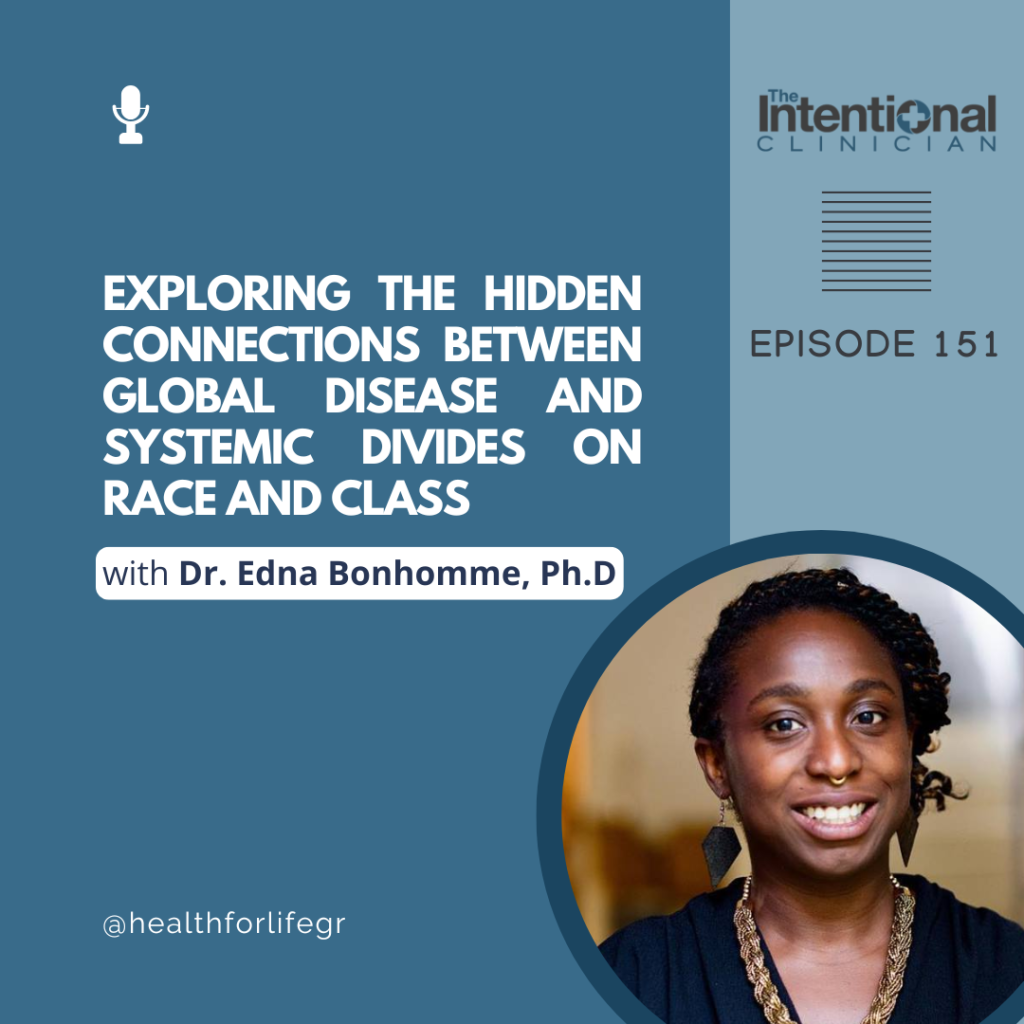
[Episode 151 of the Intentional Clinician Podcast]
Unveiling the Hidden Connections: Disease, Inequality, and Power with Dr. Edna Bonhomme
When we think of pandemics, images of overwhelmed hospitals, frantic scientists, and anxious headlines often come to mind. But beneath the surface of every global outbreak lies a deeper, more insidious story-one that Dr. Edna Bonhomme, historian of science and author of *A History of the World in Six Plagues*, brings to light with clarity and urgency. Her recent conversation with Paul Krauss on the podcast “Exploring the Hidden Connections Between Global Disease and Systemic Divides on Race and Class” invites us to look beyond the biology of disease and into the tangled web of history, power, and inequality that shapes who gets sick, who suffers most, and who is left behind.
Plagues as Mirrors of Society
Dr. Bonhomme’s approach is both historical and deeply personal. Drawing on her background as a descendant of Haitian working-class parents and her training in biology and public health, she frames six devastating epidemics-cholera, sleeping sickness, the Spanish Flu, HIV/AIDS, Ebola, and COVID-19-not just as medical events, but as social and political phenomena[4][6]. Each chapter in her book is a case study in how disease outbreaks expose and amplify the fractures in our societies.
As Bonhomme argues, pandemics do not become catastrophic by chance alone. Rather, they are “exacerbated by the racial, economic, and sociopolitical divides we allow to bloom in times of good health”[4]. The true disaster of a plague is not only in the pathogen itself, but in the human systems-of power, prejudice, and neglect-that determine its course.
Captivity, Contagion, and the Politics of Blame
One of the most striking themes in Bonhomme’s work is the connection between captivity and contagion. She traces how forced labor, confinement, and austerity have historically fueled the spread of infectious diseases[3][6]. For example, the treatment of cholera among enslaved Africans on plantations reveals how economic exploitation and racial hierarchy dictated who received care-and who was left to die[4][6].
This pattern repeats across the plagues Bonhomme studies. During the sleeping sickness epidemic in colonial Africa, authorities created concentration camps and conducted unethical medical experiments on local populations, reflecting both the literal and figurative captivity of colonized peoples[4][6]. In the HIV/AIDS crisis of the 1980s, Haitians in the United States were scapegoated as the alleged source of the epidemic, leading to ostracism and violence[4]. These stories are not anomalies; they are the rule in a world where disease often becomes a pretext for reinforcing existing systems of oppression.
COVID-19: A Contemporary Case Study
The COVID-19 pandemic, as Bonhomme highlights, is only the latest chapter in this history. The virus itself did not discriminate, but its impact was anything but equal. Marginalized communities-Black, brown, working-class, and immigrant populations-bore the brunt of the crisis, both in terms of health outcomes and economic fallout[5][6]. Meanwhile, the wealthy were often able to shelter in relative safety, protected by resources and policy decisions that prioritized their well-being[4][6].
Bonhomme points out that these disparities are not accidental. They are the result of “self-defeating practices” that undermine public health and deepen inequality[4]. From the lack of access to healthcare and paid sick leave, to the scapegoating of minority groups and the uneven enforcement of lockdowns, the pandemic revealed the rot that lingers in our social structures-a rot that, as Bonhomme warns, we rarely bother to clean up before the next crisis arrives[4].
Language, Narrative, and the Power to Define
Another critical insight from Bonhomme’s research is the role of language and narrative in shaping our responses to disease. Who gets to define an epidemic? Who is labeled as “contagious,” “dangerous,” or “unclean”? These questions are not merely semantic; they have real-world consequences for policy, treatment, and survival[6].
Throughout history, those in power have used disease as a justification for exclusion, surveillance, and violence. Whether it’s the medicalization of Black bodies in the American South, the criminalization of HIV-positive individuals, or the racist rhetoric surrounding COVID-19, Bonhomme shows how narratives about disease are often weaponized to maintain the status quo[4][5][6].
Personal Storytelling as Resistance
What sets Bonhomme’s work apart is her commitment to “critical storytelling and collective power.” She weaves her own family’s history and her experiences as a Black woman and scholar into her analysis, refusing to treat epidemics as distant or abstract[4][6][7]. This personal dimension is not a detour from the historical narrative-it is the heart of it. By centering the voices and experiences of those most affected by disease, Bonhomme challenges readers to confront the uncomfortable truths about our world and ourselves.
Lessons for the Future: A Call to Action
If there is a single lesson to be drawn from Bonhomme’s exploration, it is that pandemics are not only biological events, but social reckonings. They force us to ask: Who do we value? Who do we protect? And who do we leave to fend for themselves?
Bonhomme’s book is more than a history-it is a call to action. She urges us to recognize the “oppressive practices that shape our history and our present,” and to demand change[4][6]. This means not only investing in public health infrastructure, but also dismantling the systems of racism, classism, and xenophobia that make some lives more vulnerable than others.
“Pandemics do not materialise in isolation. They are part and parcel of capitalism and colonization,” Bonhomme reminds us[5].
Conclusion: Toward Collective Healing
As we move forward in a world still scarred by COVID-19 and threatened by future outbreaks, Bonhomme’s insights have never been more urgent. Her work challenges us to look beyond the headlines and statistics, to see the human stories-and the human costs-behind every epidemic. It is only by confronting the hidden connections between disease and systemic divides that we can hope to build a healthier, more just world for all.
In the end, *A History of the World in Six Plagues* is not just a chronicle of past suffering. It is a blueprint for collective healing-a reminder that, while disease may be inevitable, inequality is not[4][6].
- Get involved with the National Violence Prevention Hotline: 501(c)(3)
- Preview an Online Video Course for the Parents of Young Adults (Parenting Issues)
- Unique and low cost learning opportunities through Shion Consulting
Paul Krauss MA LPC is the Clinical Director of Health for Life Counseling Grand Rapids, home of The Trauma-Informed Counseling Center of Grand Rapids. Paul is also a Private Practice Psychotherapist, an Approved EMDRIA Consultant , host of the Intentional Clinician podcast, Behavioral Health Consultant, Clinical Trainer, Counseling Supervisor, and Meditation Teacher. Paul is now offering consulting for a few individuals and organizations. Paul is the creator of the National Violence Prevention Hotline as well as the Intentional Clinician Training Program for Counselors. Paul has been quoted in the Washington Post, NBC News, Wired Magazine, and Counseling Today. Questions? Call the office at 616-200-4433.
If you are looking for EMDRIA consulting groups, Paul Krauss MA LPC is now hosting a weekly online group. For details, click here.
For general behavioral and mental health consulting for you or your organization.
Follow Health for Life Counseling- Grand Rapids:
Instagram | Facebook | Youtube
”Alright” from the forthcoming album Mystic by PAWL (Spotify)
“Living In Wartime” from Purple Heart by Michael Callen (Spotify)
“The 1919 Influenza Blues” from Blues with a Message by Essie Jenkins (Spotify)
Sources
[1] Edna Bonhomme with Linda Villarosa – Library Talks – Apple Podcasts https://podcasts.apple.com/us/podcast/edna-bonhomme-with-linda-villarosa-a-history-of/id804982781?i=1000701880886
[2] Exploring the hidden connections between global disease and … https://www.youtube.com/watch?v=JL477VOWSzY
[3] Edna Bonhomme is a historian of science and culture writer based in Berlin. She is a contributing writer for Frieze Magazine, and her work has been published in The Atlantic, The Guardian, The London Review of Books, and The Nation, among others.Mar 13, 2025 https://www.writersdigest.com/write-better-nonfiction/edna-bonhomme-i-was-committed-to-embodying-the-identity-of-a-writer
[4] A History of the World in Six Plagues: How Contagion, Class, and … https://www.goodreads.com/book/show/176443740-a-history-of-the-world-in-six-plagues
[5] The Racialization of Pandemics: Interview with Edna Bonhomme https://gripinequality.org/15-miniseries-on-covid-19-and-inequality-the-racialization-of-pandemics/
[6] The Chris Voss Show Podcast – A History of the World in Six Plagues https://www.youtube.com/watch?v=zqfByPz4wOE
[7] About – Edna Bonhomme https://www.ednabonhomme.com/about
[8] Edna Bonhomme – Bard College Berlin https://berlin.bard.edu/people/profiles/edna-bonhomme

