
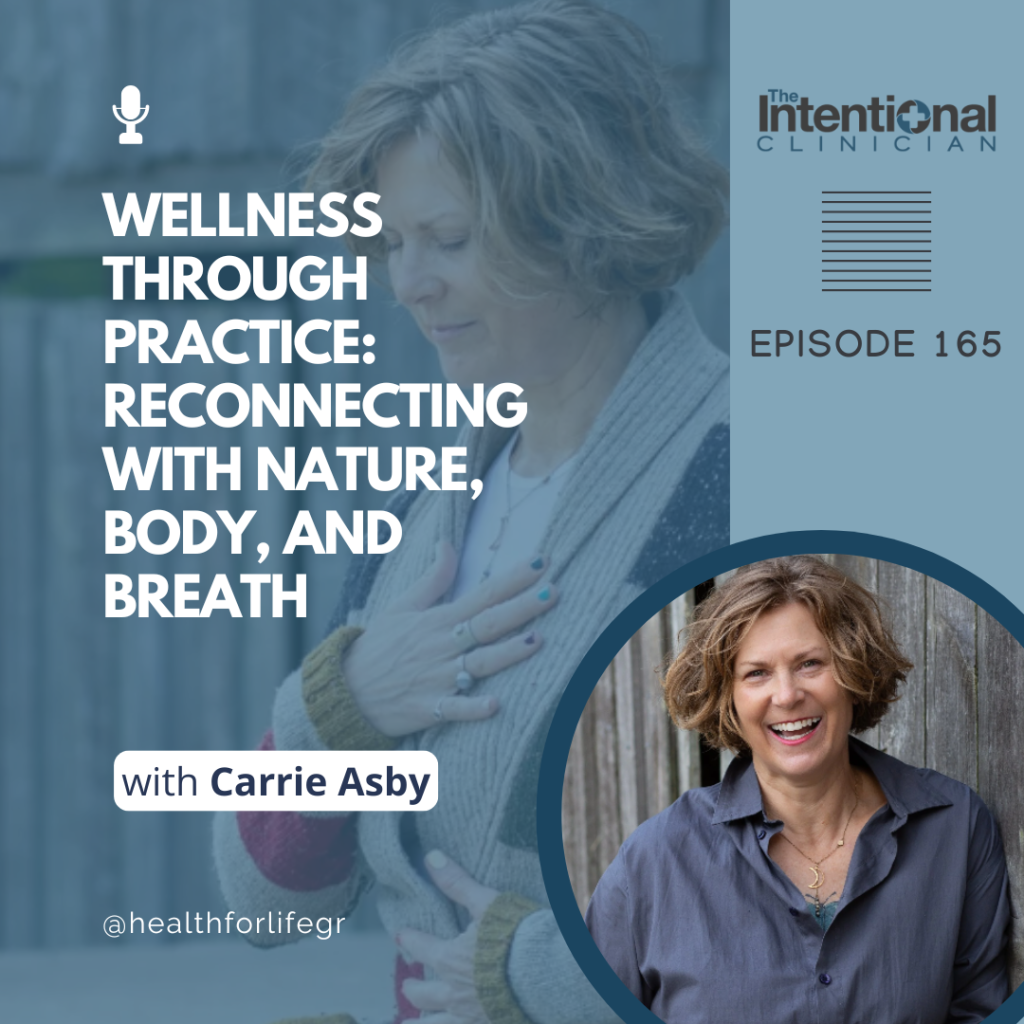
[Episode 165 of the Intentional Clinician Podcast]
In Episode 165, Wellness through Practice: Ecotherapy, Yoga, Breathing, Nature, therapist Paul Krauss sits down with wellness coach, ecotherapy guide, and author Carrie Asby for a grounded and quietly powerful conversation about what it actually means to heal in everyday life.
At its core, this episode is not about optimization or performance-it’s about remembering. Remembering the body, the breath, and our place within the natural world.
Carrie’s work-and her story-begin in a place many high-functioning individuals know well: burnout. She describes reaching a personal “rock bottom,” where chronic overwhelm and disconnection made it clear that something deeper needed to shift. What followed wasn’t a quick fix, but a gradual return to herself through simple, consistent practices-yoga, breathwork, and time in nature.
From Overwhelm to Embodiment
One of the most compelling aspects of Carrie’s perspective is her emphasis on embodiment over effort. Rather than trying to think her way out of stress, she began to feel her way back into regulation.
Practices like mindful walking, forest bathing, and sensory awareness became anchors. These weren’t elaborate routines-they were intentional moments of presence. Feeling the ground under her feet. Noticing the temperature of the air. Letting the nervous system settle through direct contact with the environment.
This shift is particularly relevant in a culture that often rewards perfectionism. Carrie speaks to how nature gently disrupts that pattern. There’s no “perfect” way to walk in the woods or breathe fresh air. In that sense, ecotherapy becomes an antidote to the chronic striving that drives many forms of anxiety and burnout.
Ecotherapy as Daily Practice
A key contribution of this conversation is how accessible it makes ecotherapy. Paul Krauss thoughtfully invites Carrie to translate her experiences into practical tools-something especially important for listeners who may not have easy access to wilderness or retreat settings.
What emerges is a reframing: ecotherapy is less about where you are and more about how you relate to your environment.
Simple practices include:
- Stepping outside for a few minutes of conscious breathing
- Bringing attention to sensory input-light, wind, temperature, sound
- Feeling the contact between your body and the physical world (feet on pavement, hands on a surface)
- Allowing moments of stillness without agenda
Even in urban settings, these micro-practices can support nervous system regulation. They interrupt the constant cognitive load many people carry and create space for the body to recalibrate.
The Nervous System and Belonging
Another thread woven throughout the episode is the idea of belonging-not as a concept, but as a felt experience.
Carrie highlights how disconnection from the natural world often mirrors disconnection from self. Re-engaging with nature, even in small ways, can restore a sense of being held within something larger. This has direct implications for the nervous system: safety is not just internal, but relational and environmental.
From a clinical lens, this aligns with growing evidence around bottom-up regulation and the role of environmental cues in shaping physiological states. Nature-based practices offer a low-barrier, non-invasive way to support this process.
Integrating Practice into Real Life
Carrie’s current work through Carrie Asby Wellness reflects this philosophy. Through retreats, coaching, and writing, she helps individuals move away from rigid self-improvement frameworks and toward sustainable, values-aligned living.
What stands out is the emphasis on practice over perfection. The goal is not to eliminate stress entirely, but to build a relationship with it-one that includes tools for returning to center.
In many ways, this episode is a reminder that healing doesn’t always require more information. Sometimes, it requires less-less noise, less striving, and more direct contact with what is already here.
The breath. The body. The ground beneath your feet.
- Get involved with the National Violence Prevention Hotline: 501(c)(3)
- Donate
- Share with your network
- Write your congressperson
- Sign our Petition
- Preview an Online Video Course for the Parents of Young Adults (Parenting Issues)
- Unique and low cost learning opportunities through Shion Consulting
Paul Krauss MA LPC is a Cofounder of Health for Life Counseling Grand Rapids, home of The Trauma-Informed Counseling Center of Grand Rapids. Paul is also a Private Practice Psychotherapist, an Approved EMDRIA Consultant , host of the Intentional Clinician podcast, Behavioral Health Consultant, Clinical Trainer, Counseling Supervisor, and Meditation Teacher. Paul is now offering consulting for a few individuals and organizations. Paul is the creator of the National Violence Prevention Hotline as well as the Intentional Clinician Training Program for Counselors. Paul has been quoted in the Washington Post, NBC News, Wired Magazine, and Counseling Today. Questions? Call the office at 616-200-4433.
If you are looking for EMDRIA consulting groups, Paul Krauss MA LPC is now hosting a weekly online group. For details, click here.
For general behavioral and mental health consulting for you or your organization.
Follow Health for Life Counseling- Grand Rapids:
Instagram | Facebook | Youtube
Original Music:
”Alright” from the album Mystic by PAWL (Spotify)
“Thirteen Sided Dice” by Cole Pulice (Spotify)

