
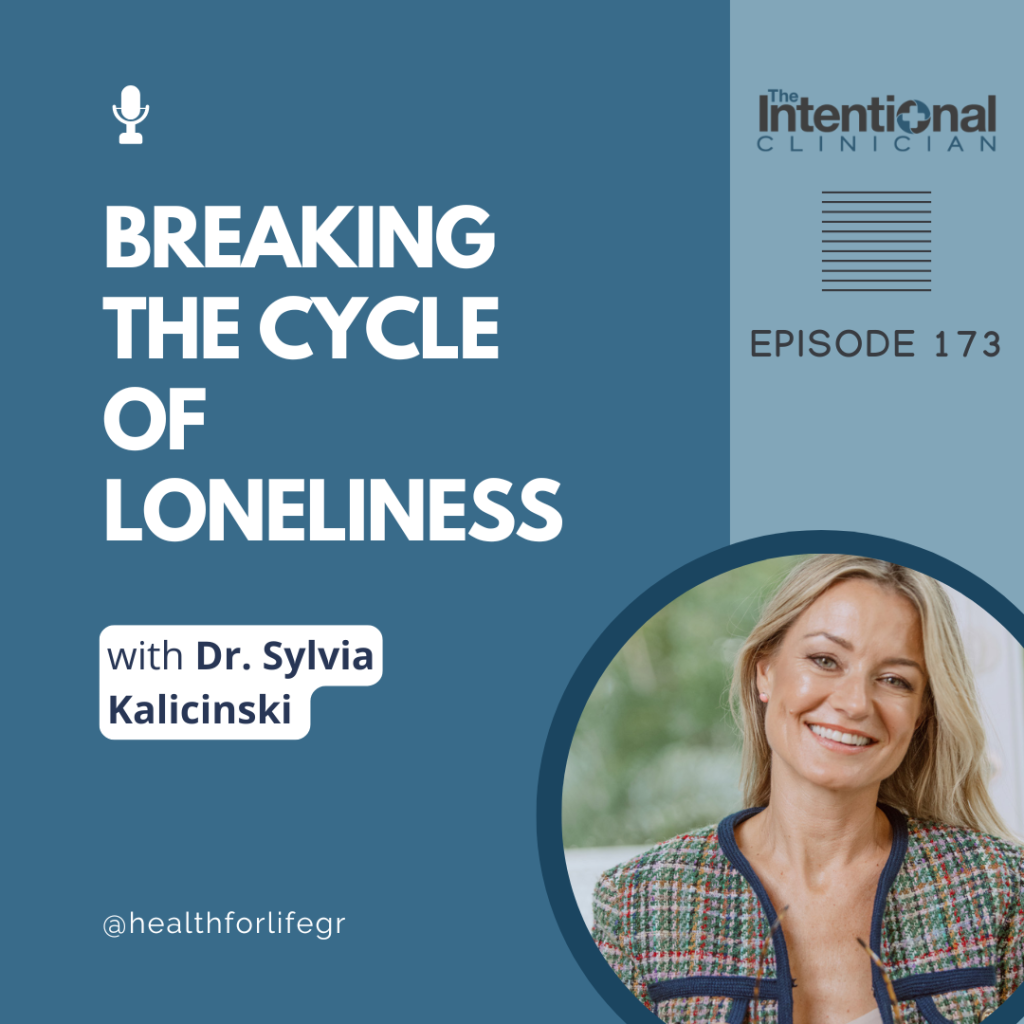
[Episode 173 of the Intentional Clinician Podcast]
In this episode, Paul Krauss, MA, LPC speaks with psychotherapist and author Dr. Sylvia Kalicinski to unpack why so many people — including high-achievers and even therapists themselves — quietly struggle with feeling alone, even when surrounded by others. Drawing on her new book, Lonely AF: A Therapist’s No BS Guide to Feeling Less Alone (Wiley/Jossey-Bass, March 2026), Sylvia shares the personal roots of her work: growing up as the child of Polish immigrants and losing her mother at a young age, experiences that shaped her clinical understanding of disconnection long before she named it professionally.
The HEART Method: a framework for coming home to yourself
Central to the episode is Sylvia’s original framework, the HEART Method, which stands for:
- Honor your emotions
- Explore your family system
- Acknowledge your pain
- Rewrite your narrative
- Turn within
Sylvia describes it as “no-fluff” and “deeply compassionate” – a deliberate rejection of both toxic positivity and cold clinical detachment. The method draws on family systems theory and neuroscience, treating loneliness not as a personal failing but as a pattern often inherited across generations. If you grew up learning to override your own needs to keep the peace, or to “handle everything alone” because that’s what survival required, disconnection can start to feel normal – even safe – long after the original threat is gone.
In conversations she’s had elsewhere about the method, Sylvia has been direct about what it takes to unwind these patterns: noticing where you self-abandon or emotionally “check out,” learning to regulate your nervous system before trying to relate to others, and practicing small, low-stakes vulnerability rather than waiting for a dramatic breakthrough. None of it is about becoming more social for the sake of it. It’s about rebuilding a sense of safety with yourself first.
One of the more striking threads in this conversation is Sylvia’s insistence that loneliness isn’t confined to people who look isolated from the outside. High achievers, people with advanced degrees, even therapists with years of training, can feel profoundly disconnected while appearing entirely put-together. That idea – that competence and credentials don’t inoculate anyone against feeling unseen – is part of what makes this topic land differently coming from a working clinician rather than a wellness influencer.
Sylvia has also been outspoken about the limits of “TikTok therapy” – the compressed, algorithm-friendly mental health advice that circulates online. It’s not that all of it is wrong, but stripped of context and nuance, it can flatten complicated healing processes into slogans. Part of what she and Paul dig into on the episode is how clinicians can hold space for real depth in a culture that increasingly rewards the opposite.
Sylvia points to a convergence of factors that make this book, and this conversation, feel timely: rising public awareness of the “loneliness epidemic,” growing interest in generational trauma, and a broader cultural willingness to talk about mental health that didn’t exist a decade ago. As a licensed psychotherapist watching these conversations happen in real time – in her office, on social media, in the broader discourse – she sees an opening to bring more nuance and clinical grounding to a topic that’s often oversimplified.
The episode also touches on practical territory listeners can use immediately: how to cope with feeling lonely inside your own family system, how to break (and start new) generational cycles, and five concrete tips for reparenting and healing the inner child. It’s the kind of episode that works whether you’re a fellow clinician looking for language and frameworks to bring into your own practice, or a listener simply trying to understand why connection still feels so hard to reach even when you’re doing everything “right.”
Dr. Sylvia Kalicinski, Ph.D., LMFT, is a psychotherapist, speaker, and author with more than 20 years of clinical experience as a Marriage and Family Therapist. She currently serves as Clinical Lead at Mount Sinai Medical Center in Miami Beach and maintains a private practice, Mindfulness Family Solutions, PLLC, in Miami. Drawing on family systems theory, neuroscience, and trauma-informed care, she developed the HEART Method — Honor emotions, Explore family system, Acknowledge pain, Rewrite your narrative, Turn within — a compassionate, no-fluff framework for emotional healing
- Get involved with the National Violence Prevention Hotline: 501(c)(3)
- Donate
- Share with your network
- Write your congressperson
- Sign our Petition
- Preview an Online Video Course for the Parents of Young Adults (Parenting Issues)
- Unique and low cost learning opportunities through Shion Consulting
Paul Krauss MA LPC is a Co-founder of Health for Life Counseling Grand Rapids, home of The Trauma-Informed Counseling Center of Grand Rapids. Paul is also a Private Practice Psychotherapist, an Approved EMDRIA Consultant , host of the Intentional Clinician podcast, Behavioral Health Consultant, Clinical Trainer, Counseling Supervisor, and Meditation Teacher. Paul is now offering consulting for a few individuals and organizations. Paul is the creator of the National Violence Prevention Hotline as well as the Intentional Clinician Training Program for Counselors. Paul has been quoted in the Washington Post, NBC News, Wired Magazine, Psychology Today, and Counseling Today. Questions? Call the office at 616-200-4433.
If you are looking for EMDRIA consulting groups, Paul Krauss MA LPC is now hosting a weekly online group. For details, click here.
For general behavioral and mental health consulting for you or your organization.
Follow Health for Life Counseling- Grand Rapids:
Instagram | Facebook | Youtube
Original Music:
”Alright” from the album Mystic by PAWL (Spotify)
“Lonely” from Closing Time by Tom Waits (Spotify)
“Little Trip to Heaven (On the Wings of Your Love)” from Closing Time by Tom Waits (Spotify)

