
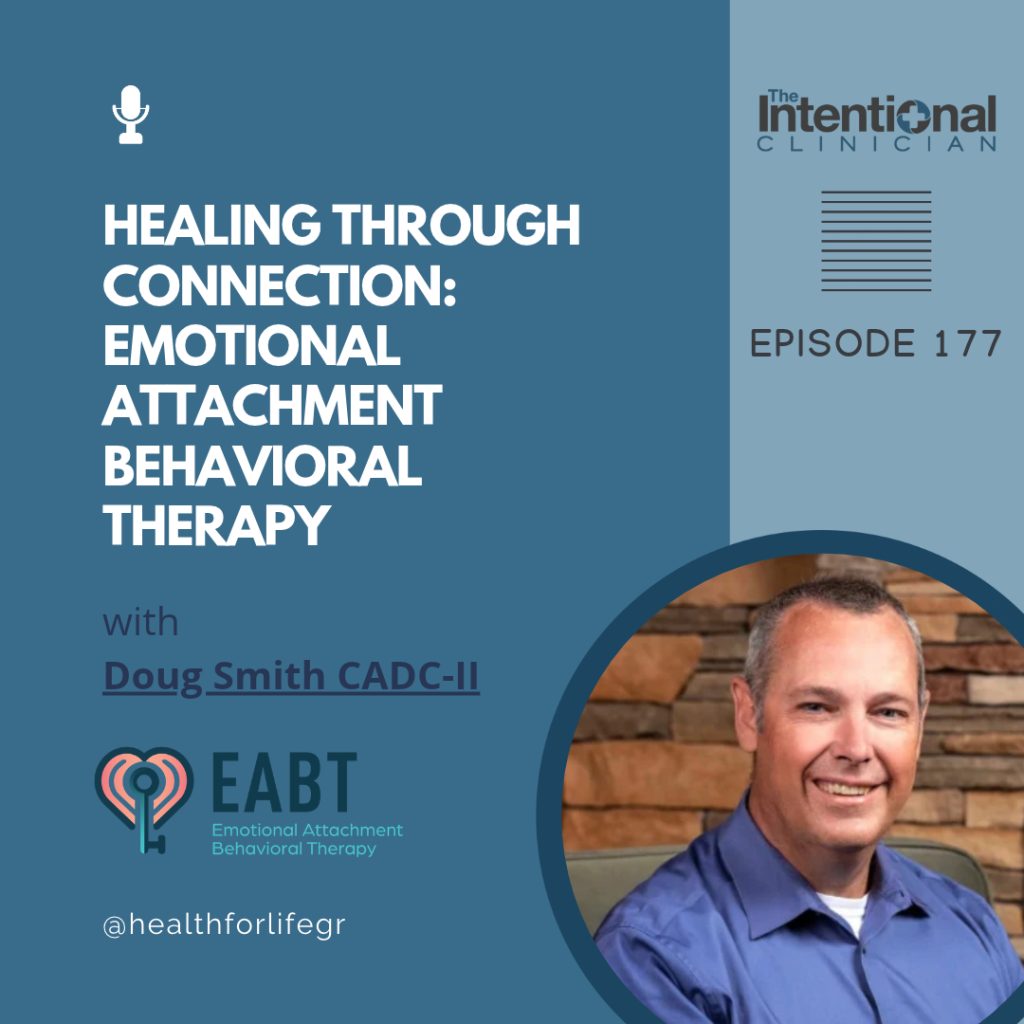
Doug Smith on Emotional Attachment Behavioral Therapy and Getting to the Root of Our Patterns: Healing Through Connection
When someone shows up in a counselor’s office, a principal’s office, or a courtroom, the conversation usually starts with the behavior. What did you use? What did you do? How do we make it stop? Those are fair questions. But they’re rarely the whole story. Underneath most of the behaviors that get people “in trouble” is something older and more tender: a nervous system that learned early on what relationships feel like, and what it takes to survive them.
That’s why I was so glad to sit down with Doug Smith, CADC II, for Episode 177 of The Intentional Clinician. Doug is the creator of Emotional Attachment Behavioral Therapy (EABT), and he’s spent 23 years in behavioral health as a direct clinician, Clinical Director, and Director of Clinical Development. His model takes on a question I think every clinician should be asking: how do we actually change patterns that were wired in during childhood?
A model born from lived experience
Doug doesn’t talk about this work from a distance. In our conversation, he shares his own history with substance use, depression, and physical abuse, and how those experiences taught him how much our earliest relationships shape the way we cope, connect, and survive. That history is what pushed him to build a model that goes after root causes instead of just managing symptoms.
I appreciate that kind of honesty. Some of the most effective helpers I’ve known are people who have walked through the fire themselves (and are willing to talk about it).
What EABT actually does
EABT is built on attachment theory. It looks at how our attachment styles interact with unhealthy behaviors, and how attachment stressors can intensify the thoughts, feelings, and behaviors that lead to poor outcomes. In plain terms: when our core relationship wounds get poked, we’re more likely to reach for whatever helped us cope before, even when it hurts us.
The EABT curriculum is organized around eight objectives:
- Understanding your attachment style and personal attachment characteristics
- Identifying core attachment stressors and where they come from
- Recognizing the physical, emotional, and mental signs that a trigger has been activated
- Building and practicing new coping skills
- Noticing negative core beliefs tied to attachment patterns, and working to change them
- Understanding how attachment patterns get passed down through families, and breaking the cycle
- Increasing secure attachment toward yourself and others
- Mapping the stages of your “attachment relapse cycle” and learning where to intervene
That last one stays with me. Framing relapse as an attachment cycle moves the conversation away from willpower and toward relationship. The question shifts from “Why did you use again?” to “What happened in your relationships, or in your sense of safety, before you got there?” That’s a far more useful question, and a far more humane one.
Meeting people where trouble shows up
Doug and I spent a good part of the episode on schools, prisons, and other settings where people tend to arrive already in trouble. It’s easy to see those moments as failures. Doug sees them as openings. When someone is already in front of a counselor, a teacher, or a program, there’s a window where real change becomes possible, if the approach meets them as a person rather than a problem.
That’s part of why the curriculum has grown so broad. There are now workbooks for adults, adolescents, couples, parents, families, students, peer support, helping professionals, LGBTQIA2S+ clients, and people with problematic sexual behaviors, plus a Spanish-language adult edition. Doug walks through examples from several of them in the episode. The model is also showing up in places like recovery high schools, including a partnership with Harmony Academy in Portland.
Treating people as human beings
In one of the unscripted stretches of our conversation (my favorite kind), Doug talks about his current work as a trainer and curriculum developer and shares success stories from clinicians and clients using the model. He also explains why he created the Problematic Sexual Behaviors workbook, and he offers a pointed critique of current prison-system approaches, including Moral Reconation Therapy and other models that aren’t trauma-informed.
His argument is simple, and I think it matters: people in the justice system are human beings who are capable of healing, and the way we treat them should reflect that. Through my work in violence prevention, I’ve come to believe that shame and isolation rarely make anyone safer. Connection is far more likely to.
Clinicians have attachment patterns too
One piece of Doug’s work I especially appreciate is the Helping Professionals workbook. It invites counselors, peer supporters, and social workers to look at how their own attachment style shows up in their work, to strengthen boundaries, and to recognize the stages of burnout before they’re deep in it. We don’t leave our histories at the door when we walk into a session. The more we understand our own patterns, the more steady and present we can be for the people we serve.
Where to start
We close the episode with practical guidance on using EABT well: where it fits, when to bring it in, and which populations tend to benefit most. If you’re a clinician, addiction professional, educator, or someone working in the justice system, that part alone is worth the listen.
And if you’re not a professional at all, here’s a place to begin. The next time you notice yourself reacting in a way you don’t like, pause and ask: what relationship, or what old feeling, just got touched? You don’t have to fix it right away. Just noticing is a start.
Doug’s closing message is the one I want to leave you with. Healing and healthy connection are possible, and understanding our attachment patterns is a powerful first step toward changing them.
About Doug Smith
Doug Smith, BS, CADC II, has 23 years of experience in behavioral health services, including work as a direct clinician, Clinical Director, and Director of Clinical Development. He holds a BS in Psychology from Eastern Oregon University and is a Certified Alcohol and Drug Counselor Level II. He developed the Emotional Attachment Behavioral Therapy (EABT) model and presents it internationally to professionals in the field. Learn more at learneabt.com or connect with Doug on LinkedIn.
Listen to the episode
You can hear our full conversation on The Intentional Clinician, Episode 177.
- Get involved with the National Violence Prevention Hotline: 501(c)(3)
- Donate
- Share with your network
- Write your congressperson
- Sign our Petition
- Preview an Online Video Course for the Parents of Young Adults (Parenting Issues)
- Unique and low cost learning opportunities through Shion Consulting
Paul Krauss MA LPC is a Co-founder of Health for Life Counseling Grand Rapids, home of The Trauma-Informed Counseling Center of Grand Rapids. Paul is also a Private Practice Psychotherapist, an Approved EMDRIA Consultant , host of the Intentional Clinician podcast, Behavioral Health Consultant, Clinical Trainer, Counseling Supervisor, and Meditation Teacher. Paul is now offering consulting for a few individuals and organizations. Paul is the creator of the National Violence Prevention Hotline as well as the Intentional Clinician Training Program for Counselors. Paul has been quoted in the Washington Post, NBC News, Wired Magazine, Psychology Today, and Counseling Today. Questions? Call the office at 616-200-4433.
If you are looking for EMDRIA consulting groups, Paul Krauss MA LPC is now hosting a weekly online group. For details, click here.
For general behavioral and mental health consulting for you or your organization.
Follow Health for Life Counseling- Grand Rapids:
Instagram | Facebook | Youtube
Original Music:

