
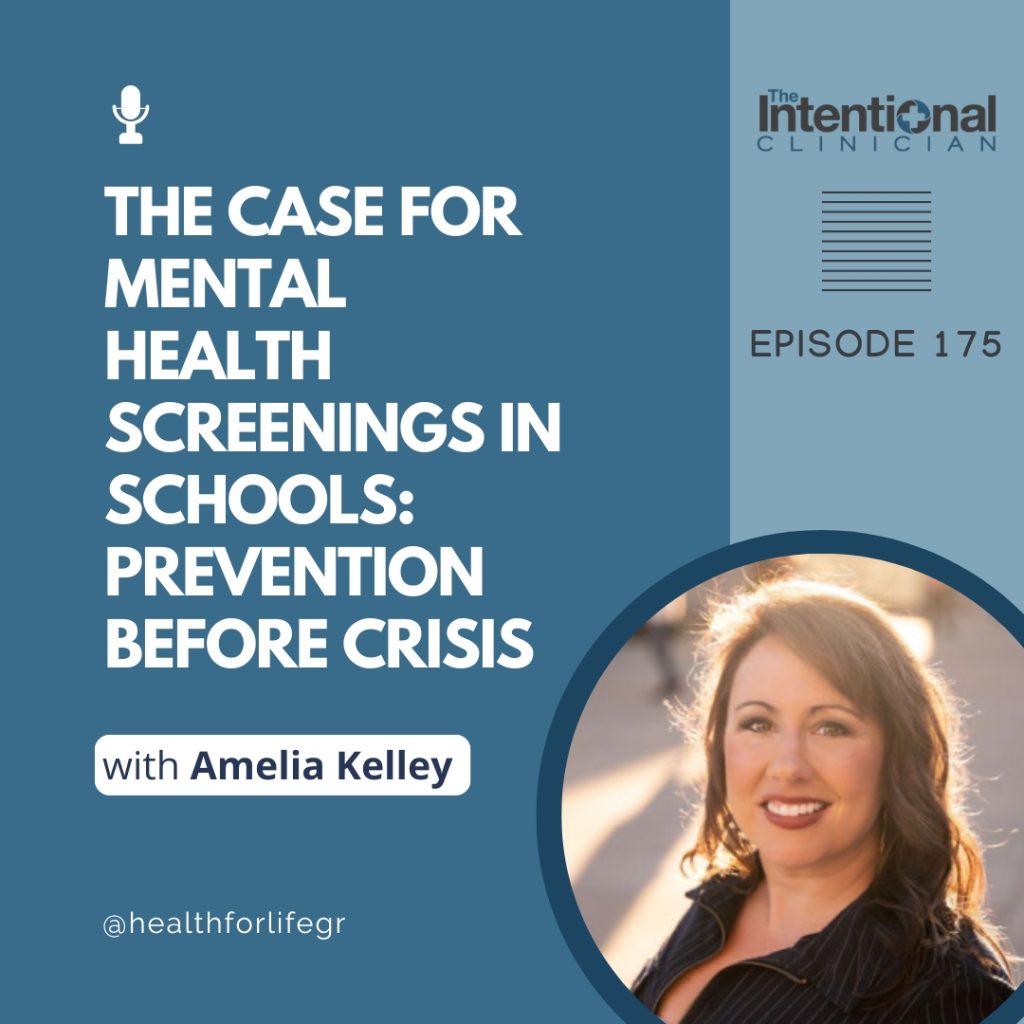
Dr. Amelia Kelley on Why Schools Should Screen for Mental Health
After almost every school tragedy, the same thing happens. Reporters, investigators, and grieving communities go back through the weeks and months beforehand, looking for what was missed. A change in behavior. A worrying post. A kid who pulled away from friends. Very often the signs were there. Nobody had a reliable way to see them in time.
Dr. Amelia Kelley wants to change that. On this episode of The Intentional Clinician, host Paul Krauss, MA LPC, talks with Dr. Kelley, a trauma-informed therapist, author, TEDx speaker, and former school counselor, about a simple idea that she argues is long overdue: checking in on students’ mental health as routinely as we check their vision and hearing.
A former school counselor’s view
Dr. Kelley’s case for screening doesn’t come from theory alone. She has worked inside schools, and she knows what teachers are up against. In her recent Psychology Today article, she describes a teacher standing in front of 25 students and being expected to teach, manage behavior, nurture kids, communicate with parents, and somehow also notice which child is quietly falling apart. She also shares something a client who taught in a Title I school told her: “There is no tired like teacher-tired.”
That’s the heart of her argument. Teachers and counselors care, often deeply. But asking already-stretched adults to catch every struggling student on instinct is not a system. It’s a hope. And kids who are good at hiding their pain, or whose distress looks like “bad behavior,” are the ones most likely to slip through.
Dr. Kelley also pushes back on how we read that behavior. What gets dismissed as “attention-seeking,” she writes, may be a child’s way of communicating pain, loneliness, or an unmet need for care (Psychology Today). A cry for help is just that. It calls for connection, co-regulation, and support, not an eye roll.
What the research shows
In her TEDx Raleigh talk, “The Case for Mental Health Screenings in Schools,” Dr. Kelley makes the point that we already accept routine health checks in schools. Nobody thinks a vision screening is intrusive. It simply catches the kid who can’t see the board before they fall behind. Mental health, she argues, deserves the same proactive approach.
The evidence backs her up. She points to a randomized clinical trial of 12,909 students in 14 Pennsylvania public high schools, published in JAMA Network Open. Half the students received universal depression screening; the other half got the usual approach, where staff refer students who seem to be struggling. The difference was striking. Students in the screening group had 5.9 times higher odds of being identified with symptoms of major depression and 2.1 times higher odds of starting treatment.
Think about what that means in practice. The referral model, the one most schools rely on, was missing most of the kids who needed help. Not because anyone was careless, but because depression in teenagers is often invisible from the outside.
National guidance points the same way. The U.S. Preventive Services Task Force recommends routine depression screening for adolescents ages 12 to 18, and the American Academy of Pediatrics recommends universal suicide-risk screening starting at age 12 (Psychology Today). The catch is that nearly 3 in 10 adolescents don’t get an annual preventive health visit. For many of them, the doctor’s office isn’t where they’ll be noticed. School is.
Prevention, not just response
Paul and Dr. Kelley spend time on why this matters beyond individual diagnoses. Her Psychology Today piece notes that many acts of school violence were preceded by observable signs of distress, and it draws on research highlighted by the National Violence Prevention Hotline showing that people involved in targeted violence often communicate distress, grievances, or a desire to be seen beforehand (Psychology Today).
That overlap is part of what makes this conversation so meaningful for this show. Prevention isn’t only about threat assessment after someone has raised an alarm. It’s about building systems where a struggling kid gets noticed, and gets help, long before despair turns into something worse.
Dr. Kelley is careful not to oversell screening. It isn’t a cure-all, and it doesn’t replace relationships with teachers, parents, counselors, and community. She calls it a doorway to intervention. The screening opens the door, and then people have to walk through it with the student.
The patchwork problem
Some states are already doing this. New Jersey, Illinois, Colorado, and Utah have moved toward statewide screening programs, and countries such as Finland, Australia, and New Zealand have built school-based screening and early-intervention efforts of their own (Psychology Today).
But in the United States, whether a student gets screened depends largely on where they happen to live. One of the threads Paul and Dr. Kelley explore is her call for federal guidance to bring some consistency to that patchwork. Right now, a child in one state might be screened every year, while a child just across the border with the same struggles might never be asked a single question about how they’re doing.
Federal guidance wouldn’t need to mean a one-size-fits-all mandate. It could mean shared standards for which tools are valid, how results are handled, and what support has to be in place before a district starts screening. That last piece matters. Screening without a plan for follow-up just produces a list of kids who need help and no way to give it to them.
Getting it right with parents
Any conversation about mental health screening in schools runs into a reasonable worry from parents: who decides what my child is asked, and what happens with the answers?
Dr. Kelley takes that concern seriously, and she argues that a responsible model has to be built around parental rights. In her framework, a good program would (Psychology Today):
- Offer an opt-out process so families can decline.
- Use brief, validated, age-appropriate tools, many of which are free.
- Screen during non-instructional time, such as homeroom, so it doesn’t cut into learning.
- Time it thoughtfully: annually, at major school transitions like the move to middle or high school, or when concerns come up.
- Notify parents when a concern is identified, and give them referral options.
- Let parents request results even when nothing concerning turns up.
That approach treats parents as partners rather than obstacles. It also recognizes something families often already know: kids sometimes tell a questionnaire what they can’t yet say out loud at home.
Referral pathways are the other piece. Dr. Kelley points to school-based counseling, consultation with outside providers, expanded telehealth, and partnerships with organizations such as the Choose Love Movement, founded by Scarlett Lewis after her son Jesse was killed at Sandy Hook, and Ambassadors of Compassion. Screening only works when there is somewhere for a child to go next.
Beyond screening: her broader work
The conversation also widens out into the rest of Dr. Kelley’s work, much of which centers on people who have been told they are “too much.”
Her book Powered by ADHD offers research-backed strategies for women with ADHD, focusing on strengths, flexibility, and self-compassion rather than deficits. Surviving Suicidal Ideation, co-written with Gina Cavalier, brings together therapy, spirituality, and lived experience, with tools for people living with suicidal thoughts and a foreword by Thomas Moore, author of Care of the Soul. She is also the author of Gaslighting Recovery for Women and What I Wish I Knew, which support survivors of emotional and relational abuse.
Those books connect directly to the school conversation. Many of the kids who go unnoticed are the sensitive ones, the neurodivergent ones, the ones who mask well. Dr. Kelley, who describes herself as highly sensitive and neurodivergent, knows that experience from the inside (Amelia Kelley). It’s part of why she explores those themes on her podcast, Wired & Worthy, where the message is that being wired differently doesn’t make anyone less worthy.
Paul and Dr. Kelley also talk about her work training clinicians around the world on trauma, ADHD in women, suicide prevention, and nervous system-informed care. For therapists listening, there’s plenty to take back into practice, especially around how dysregulation and distress show up in young people long before anyone puts a name on it.
Why this conversation matters now
Dr. Kelley ends her Psychology Today piece with a simple question: “Why aren’t we doing this already?” It’s a fair one. We have validated tools, strong evidence, national recommendations, and states already showing that it can work. What’s missing is the will to make it standard.
For clinicians, this episode offers a clear, research-grounded way to talk about school-based prevention. For educators, it’s a reminder that they shouldn’t have to carry the job of spotting every struggling student alone. And for parents, it’s a chance to hear what a screening program should look like when it’s done respectfully, with families at the center.
Kids rarely go from fine to crisis overnight. There is usually a stretch of time when someone could have asked, “How are you really doing?” Dr. Kelley’s work is about making sure that question actually gets asked.
Dr. Amelia Kelley is a trauma-informed therapist, author, international trainer, and former school counselor whose work centers on transforming how we understand and support mental health across schools, families, and communities. A longtime advocate for school mental health reform, her TEDx talk on rethinking student mental health was named an Editors’ Pick. She is the author of several books, including Powered by ADHD, Gaslighting Recovery for Women, and Surviving Suicidal Ideation, and trains clinicians internationally on trauma, ADHD in women, suicide prevention, and nervous system-informed care. Dr. Kelley’s expertise has been featured in TIME, Psychology Today, Chicago Tribune, Psychotherapy Networker, ADDitude, NPR, and other national media. She also hosts the Wired & Worthy podcast, where she explores what it means to be wired differently — and worthy always.
- Get involved with the National Violence Prevention Hotline: 501(c)(3)
- Donate
- Share with your network
- Write your congressperson
- Sign our Petition
- Preview an Online Video Course for the Parents of Young Adults (Parenting Issues)
- Unique and low cost learning opportunities through Shion Consulting
Paul Krauss MA LPC is a Co-founder of Health for Life Counseling Grand Rapids, home of The Trauma-Informed Counseling Center of Grand Rapids. Paul is also a Private Practice Psychotherapist, an Approved EMDRIA Consultant , host of the Intentional Clinician podcast, Behavioral Health Consultant, Clinical Trainer, Counseling Supervisor, and Meditation Teacher. Paul is now offering consulting for a few individuals and organizations. Paul is the creator of the National Violence Prevention Hotline as well as the Intentional Clinician Training Program for Counselors. Paul has been quoted in the Washington Post, NBC News, Wired Magazine, Psychology Today, and Counseling Today. Questions? Call the office at 616-200-4433.
If you are looking for EMDRIA consulting groups, Paul Krauss MA LPC is now hosting a weekly online group. For details, click here.
For general behavioral and mental health consulting for you or your organization.
Follow Health for Life Counseling- Grand Rapids:
Instagram | Facebook | Youtube
Original Music:
”Alright” from the album Mystic by PAWL (Spotify)
“Diversey Beach” featuring Mei Semones from Horizon by Resavoir & Matt Gold (Spotify)

