
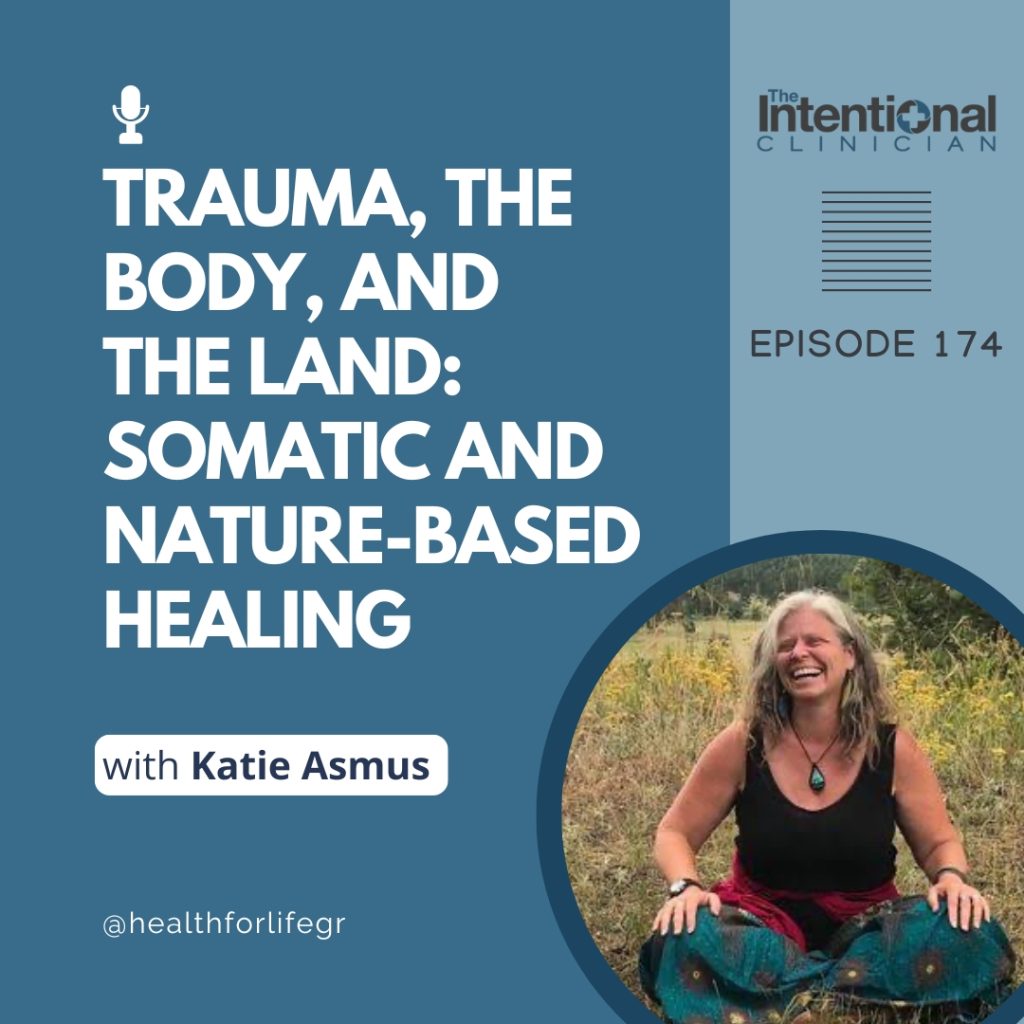
[Episode 174 of the Intentional Clinician Podcast]
What Katie Asmus Teaches Us About Healing Beyond Words
Most of us were trained to heal through conversation. We sit across from someone, we listen, we reflect, and we help them find language for what happened. That work matters. But anyone who has spent real time with trauma knows the limits of it. A client can tell the story perfectly, understand exactly why they react the way they do, and still feel their chest tighten when a door slams. Insight arrives, and the body doesn’t get the memo.
That gap between what we know and what we feel is where Katie Asmus has spent her career. On Episode 174 of The Intentional Clinician, host Paul Krauss, MA LPC, speaks with Katie Asmus, MA, LPC, BMP, founder of the Somatic Nature Therapy Institute in Boulder, Colorado, to talk about what happens when trauma work leaves the office and moves into the body, onto the land, and into ceremony. It’s a conversation that stays with you, partly because Katie is so grounded, and partly because she names things many clinicians sense but rarely say out loud.
An unlikely wilderness guide
Katie’s story doesn’t start where you might expect. She grew up in the suburbs of Cleveland, where “the woods” meant a row of shrubs in the backyard and a mulberry tree out front, and by her own account she hated getting dirty (Somatic Nature Therapy Institute). Girl Scout horse camp cracked something open for her. Then, in her first semester of college, a leadership course brought her to a high ropes course about 30 feet off the ground. She moved through her fear of heights and came down knowing what she wanted to do with her life.
It’s a fitting origin story, because it’s a small version of what she now offers others. She didn’t become an outdoor person by being naturally fearless. She got there by being supported through something that scared her, and discovering in her body, not just her head, that she could do more than she thought. That’s a pretty good description of trauma recovery.
What followed was more than three decades of leading groups outdoors with organizations like Outward Bound and the Women’s Wilderness Institute, counseling since 1995, and nearly twenty years teaching in the wilderness therapy and somatic psychology programs at Naropa University and in adventure-based psychotherapy and ecopsychology at Prescott College (Somatic Nature Therapy Institute). She’s also an EMDR trainer and consultant, which gave her and Paul, an Approved EMDRIA Consultant, plenty of common ground.
Why so much healing lives below language
A theme Paul and Katie keep returning to is that trauma is not only a memory. It’s a pattern held in the nervous system: in posture, breath, startle responses, and the ways we brace or collapse without meaning to. Talk therapy can reach some of that. Much of it, though, has to be met where it lives.
Katie’s framing of this is hopeful rather than pathologizing. She talks about an “organismic brilliance,” the idea that the same intelligence that helps a person survive something terrible is the intelligence that eventually helps them heal from it (Somatic Nature Therapy Institute). The freeze, the hypervigilance, the numbness: these were solutions once. Somatic work doesn’t try to override them. It gets curious about them, helps the body complete what it couldn’t complete at the time, and slowly offers the nervous system new options.
For clinicians, this is a meaningful shift in stance. Instead of being the expert who fixes, you become more of a guide who helps someone listen to their own signals. That’s harder in some ways, because it asks us to slow down and tolerate not knowing. But it’s also a relief. The wisdom isn’t all supposed to come from the therapist.
Nature as a co-therapist
This is where Katie’s work gets really interesting. Plenty of therapists will tell you nature is good for mental health, and they’re right. Katie goes further. Her institute describes nature “not as a backdrop, but as a co-therapist and facilitator,” a living presence that “reminds us who we are beneath the layers” (Somatic Nature Therapy Institute).
What does that look like in practice? A few ideas stand out.
First, the natural world regulates. Wind, the feel of the ground underfoot, light moving through trees: these are sensory experiences that are usually neutral or pleasant, and for a nervous system stuck in threat mode, neutral is a gift. The institute’s writing points out that simply being outside, even walking, sitting, or looking out a window, can help get things moving when someone feels stuck (Somatic Nature Therapy Institute).
Second, nature offers metaphors that don’t shame us. We don’t judge a tree for dropping its leaves or a hillside for going brown in winter. Life, death, decay, and renewal all happen side by side without hierarchy. For a client who feels broken because they’re grieving “too long” or can’t get back to who they used to be, that can land more deeply than anything said from a therapist’s chair.
Third, the land doesn’t have an agenda. A therapist, however skilled, still brings their own reactions into the room. A river doesn’t. There’s a kind of witnessing that happens outdoors that feels less loaded, and many people find they can let their guard down in ways they can’t indoors.
Ceremony, ritual, and the messy middle
One of the most valuable threads in this conversation is about ritual. Our culture is not very good at marking change. We have weddings and funerals, and not much in between. Divorces, job losses, a child leaving home, a diagnosis, the end of a friendship, the slow realization that you’re not who you used to be: most of these we’re expected to absorb quietly and move on.
Katie’s work draws on the rites of passage model, which describes change in three phases: severance, when something ends; the liminal stage, the in-between; and incorporation, when we step into a new way of being (Somatic Nature Therapy Institute). The middle is where most of us get lost. We want to rush from the ending straight to the new beginning, and the institute notes that skipping the middle tends to show up later as chronic stress, unresolved grief, anxiety, and disconnection from the body.
From this perspective, the in-between isn’t a problem to fix. It’s a process to live through (Somatic Nature Therapy Institute). Ceremony is one of the oldest ways humans have done that. It doesn’t have to be elaborate or borrowed from a tradition that isn’t yours. It can be as simple as a clear intention, a meaningful action, and someone, or something, to witness it. Katie is careful about the difference between cultural appropriation and creating ceremony that is personally meaningful and culturally relevant, and that distinction is built into how she trains others.
Clinically, this is compelling. So much of what shows up in therapy is unfinished transition. People carrying losses nobody acknowledged, or identity shifts nobody honored. Giving them a way to mark those moments, with their body involved and not just their words, can help something finally settle.
Solo time and the wisdom within
Katie also leads wilderness quests and retreats that include intentional time alone in nature. That might sound intimidating, like something reserved for hardcore backpackers. It isn’t. The institute is clear that solo time doesn’t require going far or staying long. A few hours on a local trail, a quiet morning in a park, or a corner of your own backyard can be enough. The point is the intention, what they call “the sacred pause” (Somatic Nature Therapy Institute).
There’s something lovely about the simple questions they suggest for coming back from that kind of time: Who went out? Who came back? What gifts are you bringing back to your community? Those questions would work just as well at the end of a therapy session, or a hard year.
Therapists need this too
A big piece of the conversation focuses on clinicians. Katie doesn’t only work with clients; she trains and mentors therapists, coaches, and other helpers, and a lot of that work is about helping them reconnect with their own inner wisdom so they don’t burn out.
This will hit close to home for a lot of listeners. Many of us got into this field because we care deeply, and the work can slowly erode the very things that make us good at it. We become skilled at attending to everyone else’s nervous system and forget we have one. One therapist who worked with Katie described going from burned out to “energized, excited, and passionate” about the work again (Somatic Nature Therapy Institute). That kind of shift rarely comes from learning another technique. It comes from being reminded that you’re a whole person, and that your body, your intuition, and your relationship with the world around you are resources too.
If you’re a clinician feeling the edges of talk therapy, or the edges of your own energy, this episode is worth your time. It’s an invitation to expand what counts as treatment and to take your own restoration as seriously as your clients’.
A few things to try
You don’t need a wilderness retreat to start working with these ideas. A few small places to begin:
- Take your next hard conversation with yourself outside. Walk, sit on the ground, or just stand at a window. Notice what changes in your body when you’re not boxed in.
- Name a transition you never marked. It might be a loss, an ending, or a version of yourself you’ve outgrown. Ask what a simple, personal ritual of acknowledgment might look like.
- Let the in-between be the in-between. If you’re in a stretch where the old thing is over and the new thing hasn’t arrived, try treating it as a season rather than a failure.
- For therapists, schedule your own sacred pause. Put an hour on the calendar that belongs to you and the land. Keep it simple and keep it real.
About Katie Asmus
Katie Asmus, MA, LPC, BMP, is a somatic and nature-based psychotherapist, EMDR trainer, and rites of passage guide who founded the Somatic Nature Therapy Institute in Boulder, Colorado. Trained in somatic psychology at Naropa University, she has spent more than three decades guiding people outdoors and teaching the next generation of wilderness and somatic therapists. Her trainings, quests, and mentorship programs are listed at somaticnaturetherapy.com.
Listen to the full episode
Hear the full conversation on The Intentional Clinician, Episode 174, or wherever you get your podcasts.
- Get involved with the National Violence Prevention Hotline: 501(c)(3)
- Donate
- Share with your network
- Write your congressperson
- Sign our Petition
- Preview an Online Video Course for the Parents of Young Adults (Parenting Issues)
- Unique and low cost learning opportunities through Shion Consulting
Paul Krauss MA LPC is a Co-founder of Health for Life Counseling Grand Rapids, home of The Trauma-Informed Counseling Center of Grand Rapids. Paul is also a Private Practice Psychotherapist, an Approved EMDRIA Consultant , host of the Intentional Clinician podcast, Behavioral Health Consultant, Clinical Trainer, Counseling Supervisor, and Meditation Teacher. Paul is now offering consulting for a few individuals and organizations. Paul is the creator of the National Violence Prevention Hotline as well as the Intentional Clinician Training Program for Counselors. Paul has been quoted in the Washington Post, NBC News, Wired Magazine, Psychology Today, and Counseling Today. Questions? Call the office at 616-200-4433.
If you are looking for EMDRIA consulting groups, Paul Krauss MA LPC is now hosting a weekly online group. For details, click here.
For general behavioral and mental health consulting for you or your organization.
Follow Health for Life Counseling- Grand Rapids:
Instagram | Facebook | Youtube
Original Music:
”Alright” from the album Mystic by PAWL (Spotify)

